Ask most builders why a job went to a competitor and they’ll tell you a story about price. Ask a bit further and the real story usually comes out: they sent the quote, the customer went quiet, and by the time anyone thought to chase it, the job was gone. A CRM for builders exists to fix exactly that gap — not the pricing, the follow-up.
It’s a familiar pattern on a building firm’s diary: a strong week of site visits and quotes, followed by a quiet month wondering where the work went. The quoting wasn’t the problem. What happened after the quote was.
Why Builders Lose Jobs They Should Have Won
Most building firms run enquiries the same way: a call or a WhatsApp message comes in, someone scribbles the details, a quote goes out by email a few days later, and then… nothing. No reminder to follow up. No record of who was meant to chase it. The customer gets three quotes, and the firm that calls back first usually wins — regardless of who was cheaper or better. This isn’t just a trade hunch either: research published in the Harvard Business Review on over 100,000 sales contact attempts found that firms responding to a new enquiry within an hour were roughly seven times more likely to have a meaningful conversation with the buyer than those who waited even a little longer.
This isn’t a work ethic problem. Builders are busy running sites, not sitting at a desk chasing paperwork. The issue is that there’s no system holding the process together once the tape measure goes back in the van. A spreadsheet or a stack of paper quotes can’t remind anyone that a lead has gone quiet for six days.
Signs Your Building Firm Is Losing Jobs To Poor Follow-Up
Most builders don’t realise how much work is slipping away until they actually start tracking it. A few patterns are worth checking for:
- You send a quote and genuinely can’t remember the last time you followed up on one that went quiet
- Enquiries live across three or four places — a notebook, WhatsApp, a shared inbox, someone’s memory
- You can say roughly how many jobs you won this month, but not how many quotes you sent to get there
- Repeat customers or referrals occasionally get missed because nobody flagged them for a follow-up call
- Quoting and admin happen in the evenings, after a full day on site
None of these are unusual for a busy trade business — they’re the default state for most firms without a system behind the scenes. The point isn’t that anyone is doing anything wrong; it’s that the volume of enquiries a growing firm handles eventually outpaces what memory and notebooks can reliably hold onto.
What a CRM For Builders Actually Does
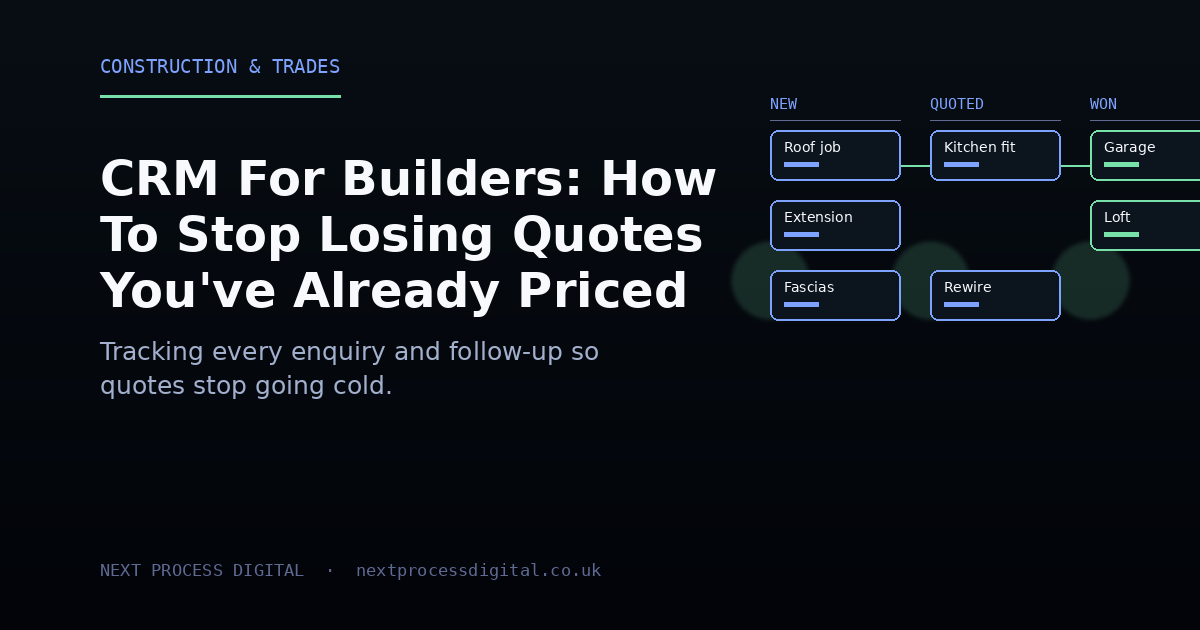
A proper CRM for builders isn’t a generic sales tool bolted onto a construction business. Done right, it should track a job through the stages that actually matter on-site:
- Enquiry received — captured automatically from calls, forms, or WhatsApp, not scribbled on the back of an invoice
- Site visit booked — with a reminder so it’s never missed or double-booked
- Quote sent — logged with a date, so everyone knows exactly how old it is
- Follow-up due — an automatic nudge if a quote hasn’t had a response within a set number of days
- Job won or lost — tracked, so you can actually see your conversion rate instead of guessing
That last point matters more than most builders realise. Without it, there’s no way to know whether the business has a pricing problem, a follow-up problem, or a genuinely quiet month. Most of the time, once the numbers are actually tracked, it turns out to be follow-up.
Want to see what this looks like for your business specifically? Get in touch and we’ll walk through it.
The Follow-Up Window That Decides Most Jobs
Homeowners and developers getting building work done rarely commit to the first quote they receive. They wait to see who else responds, and a large share of decisions are made in favour of whoever follows up while the job is still front of mind — not necessarily whoever was cheapest. A trade body like the Federation of Master Builders has long pushed for better customer communication standards in the industry for exactly this reason: trust and responsiveness win work as often as price does.
A CRM for builders automates the part that’s easy to forget under pressure — the nudge that says “this quote’s gone quiet, follow up today.” That single reminder, sent consistently, tends to recover jobs that would otherwise have quietly gone elsewhere.
Picture a typical week: five site visits, five quotes sent by Friday evening. By the following Friday, two customers have come back with questions, one has confirmed, and two have gone silent. Without a system, those two silent ones just sit there — nobody’s actively ignoring them, there’s just no trigger telling anyone to pick up the phone. A CRM flags both automatically on day five or six, while the job is still live in the customer’s mind rather than something they quietly booked with someone else. Over a year, that’s the difference between chasing every lead by accident and recovering jobs on purpose.
Quick Reference: Manual Process vs. CRM-Managed Process
| Without a CRM | With a CRM for builders |
|---|---|
| Enquiries scattered across texts, calls, and a notebook | Every enquiry logged in one place automatically |
| Follow-up depends on someone remembering | Automatic reminder if a quote goes unanswered |
| No visibility on how many quotes convert | Clear conversion rate, job by job |
| Repeat customers can slip through the cracks | Past customers flagged for future work and referrals |
| Admin done evenings and weekends | Most of it handled automatically during the week |
A CRM Only Works If Enquiries Actually Reach It
A CRM for builders solves what happens after an enquiry lands — but that assumes enquiries are landing consistently in the first place. If a firm’s website isn’t ranking for the searches local homeowners are making, or the enquiry form is buried three clicks deep, the CRM has nothing to work with. The two problems are connected: a website that generates a steady flow of enquiries, feeding into a CRM that makes sure none of them go cold, is what actually moves a building firm from feast-and-famine to a predictable pipeline.
This is why we treat website, SEO, and CRM as one connected system rather than three separate projects bought from three separate suppliers. Fixing the follow-up problem without fixing the visibility problem — or the other way round — only solves half of it. If enquiries aren’t landing consistently in the first place, it’s worth starting with the local SEO basics that matter for trade businesses, and once the CRM is in place, automation can take a lot of the manual chasing off your plate entirely.
Where This Matters Most For Trades Around Bicester
Building and trade firms working across Bicester and the surrounding area are often competing on the same new-build estates and renovation projects, frequently for the same pool of homeowners getting three or four quotes before deciding. In that environment, a firm that replies within a day has a real edge over one that replies within a week, even when the pricing is nearly identical. We work with construction and trade businesses across this area to set up a CRM that matches how building firms actually operate — site visits, quotes, and jobs that can run for weeks or months, not a generic sales pipeline built for software companies.
The same pattern hits roofers even harder, given how weather-driven their enquiry volume is — see our companion piece on Roofing SEO Agency for how a CRM and fast response work together during a storm-driven surge, and on SEO for Builders for the visibility side that feeds this CRM in the first place.
Frequently Asked Questions
Is a CRM for builders complicated to set up?
Not if it’s built around your existing process rather than forcing you to learn new software from scratch. Most building firms are up and running within a couple of weeks, tracking enquiries from day one.
We’re a small team — do we really need this?
If quotes are currently tracked in your head, a notebook, or a shared inbox, yes. The smaller the team, the more a missed follow-up costs, because there’s nobody else to catch it.
Will this replace how we currently quote jobs?
No. It sits around your existing quoting process and makes sure nothing gets forgotten once the quote is out the door — it doesn’t change how you price or write up a job.
What’s the difference between this and a generic CRM off the shelf?
Off-the-shelf CRMs are usually built for sales teams working phone-based deals, not builders juggling site visits, quotes that take days to price properly, and jobs that run for weeks. A CRM for builders is set up around that reality from the start, rather than adapted after the fact.
If quotes are going out but the phone’s not ringing back, the fix usually isn’t your pricing. Get in touch and we’ll show you exactly where your enquiries are falling through.