A candidate gets submitted for a project engineer role on a Monday. The client asks for feedback by Wednesday. Nobody flags it anywhere — just a note in someone’s head to “chase the client Wednesday.” Wednesday comes and goes. By Friday, the candidate has accepted a role with an agency that called back first, and the consultant only finds out when the candidate stops answering calls. This happens on recruitment desks every week, and it rarely comes down to a weak candidate or a bad brief. It comes down to nobody having a system tracking who owed who a follow-up.
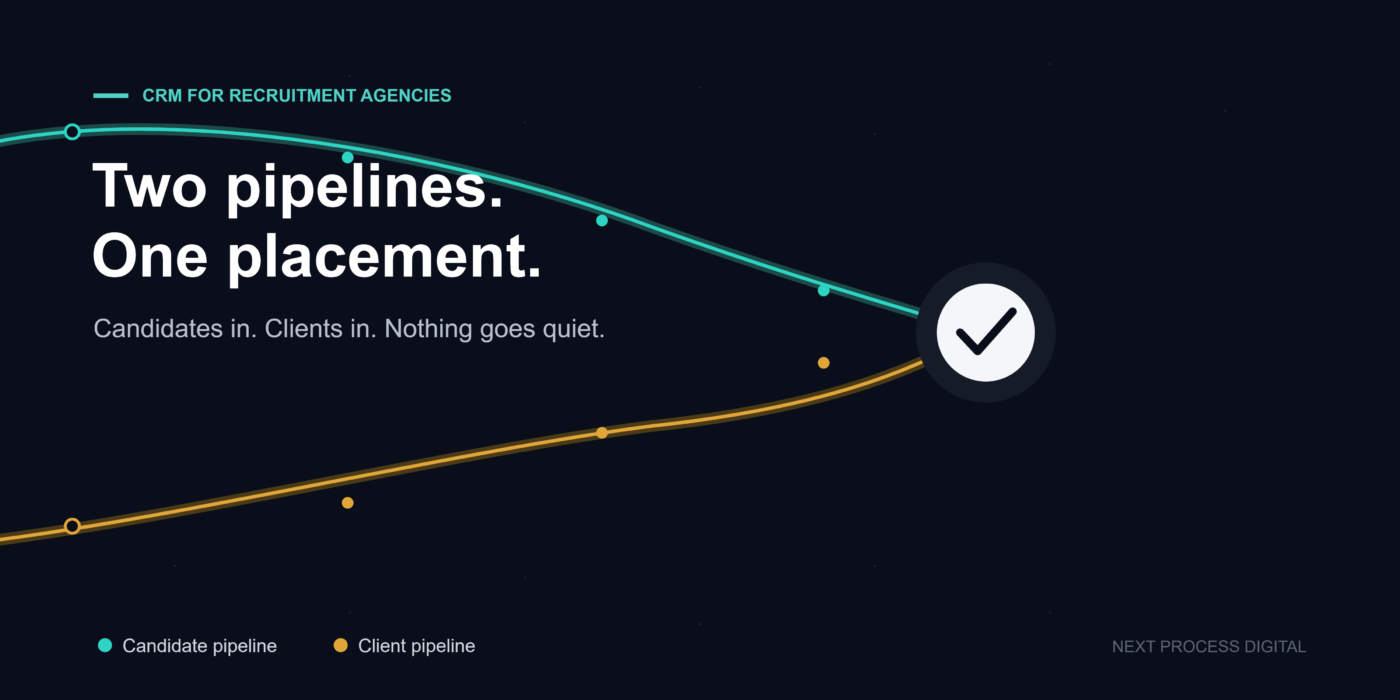
This is exactly the gap a proper CRM for recruitment agencies is supposed to close — not a generic contact database, but a system built around two pipelines running at once: candidates moving through a process, and clients moving through a hiring decision, both touching the same placement at different points.
Short answer: a CRM for recruitment agencies needs to run a candidate pipeline and a client vacancy pipeline side by side, automatically match new vacancies against candidates already on file, trigger follow-up reminders on both sides, and keep compliance documents attached to the candidate record. Generic sales CRMs assume one pipeline moving to a single close — recruitment needs two, connected, moving at the same time.
Last reviewed 24 July 2026 by wren, who builds CRM and automation systems for engineering, trade, hospitality and recruitment businesses at Next Process Digital and has configured candidate-and-client pipelines for specialist recruitment desks across Oxfordshire and Northamptonshire.
This isn’t just a hunch about how agencies lose placements. Research from Morgan McKinley, reported by SocialTalent, found that half of all UK professionals have turned down a job offer because the hiring process took too long — and separate research from HR Dive found that only 19% of candidates hear back from a recruiter within 24 hours, despite roughly 80% wanting exactly that. A desk that can’t move fast because nothing is tracked automatically isn’t just inefficient — it’s actively losing placements to whichever agency responds first.
Why Generic CRM Advice Doesn’t Fit Recruitment
Most CRM guides assume a single pipeline: a lead moves through stages toward one close. That works for software sales. It doesn’t work for recruitment, where a single placement depends on two things happening in parallel — a candidate progressing through screening and interviews, and a client vacancy progressing through briefing, shortlisting and offer — and where the desk is often running dozens of both at once across multiple sectors.
Install a generic sales CRM without reconfiguring it for this, and consultants tend to quietly abandon it within a few months, going back to a shared inbox, a spreadsheet, and whoever remembers to chase what. The software isn’t usually the problem. The pipeline was never built around how a desk actually works a vacancy.
If candidates and vacancies currently live across email, spreadsheets and memory, get in touch and we’ll walk through what a system built around your actual desks would look like.
What A CRM For Recruitment Agencies Actually Needs To Track
Strip away the software marketing and a recruitment CRM needs to do a fairly specific list of things well:
- Candidate pipeline — registered, screened, submitted, interviewing, offer, placed — with full history, so a candidate is never treated as new the second time they’re worth approaching
- Client vacancy pipeline — briefed, candidates submitted, interviews arranged, offer stage, filled — giving a real-time view of every live role
- Automatic matching — when a new vacancy comes in, the system surfaces candidates already on file who fit, rather than relying on a consultant’s memory
- Follow-up reminders on both sides — for clients waiting on feedback and candidates waiting on updates, so neither goes quiet through oversight
- Compliance and document tracking — right-to-work checks, references and contracts attached directly to the candidate record, not scattered across email
A pattern we see repeatedly when we take on a new CRM build for a recruitment client: strong candidates aren’t lost at the sourcing stage, they’re lost in the gap between “submitted once, unsuccessful” and “never resurfaced for the next relevant role.” On one specialist engineering desk we onboarded, roughly a quarter of the active candidate database hadn’t been contacted in over four months, despite several matching vacancies passing through the same period. Once matching became automatic instead of memory-dependent, that pool started converting into placements again within weeks.
CRM For Recruitment Agencies vs. A Generic Sales CRM
| What’s being tracked | Generic sales CRM | CRM configured for recruitment |
|---|---|---|
| Pipeline shape | Single pipeline, one decision point | Two connected pipelines — candidate and client — running at once |
| Matching | Manual, dependent on memory | Automatic alerts when a new vacancy matches an existing candidate |
| Follow-up logic | One-sided, client-only | Reminders on both candidate and client sides |
| Candidate history | Often treated as a new lead each time | Full history retained, resurfaced for future relevant roles |
| Compliance | Not built in | Right-to-work and reference documents attached to the record |
Speed Of Follow-Up Decides More Placements Than Fee Rates
A client with an urgent vacancy is usually working two or three agencies at once, whether they say so or not. The agency that comes back first with a strong shortlist tends to win the brief, largely independent of fee percentage. This is the same principle covered in our piece on SEO for recruitment agencies: getting found by candidates and clients is only half the job. A CRM is what turns that visibility into an actual placement, by making sure nothing generated by the website, job boards or referrals sits unactioned once it arrives.
Ready to see whether your current setup is actually built for how your desks operate? Get in touch and we’ll show you where placements are currently slipping through.
What This Looks Like For Recruitment Agencies Around Bicester
Recruitment agencies working across Bicester and the wider Oxfordshire corridor are often placing into the same engineering, logistics and trades employers as several other local and national agencies. In that environment, being first to resubmit a strong candidate or first to come back with client feedback is frequently the deciding factor in who gets the placement. We work with recruitment businesses across this area to configure a CRM around exactly that reality — two pipelines, one placement, moving as fast as the desk actually needs it to.
Frequently Asked Questions
Is a CRM worth it for a small recruitment agency?
If candidates and vacancies are currently tracked in a shared inbox or spreadsheet, yes. The smaller the team, the more a missed follow-up or forgotten candidate costs, since there’s nobody else to catch it.
How is a recruitment CRM different from a generic sales CRM?
A generic CRM assumes one pipeline moving toward a single close. Recruitment needs two connected pipelines — candidates and client vacancies — running at once, which most off-the-shelf sales CRMs aren’t built to handle well.
How long does it take to set up a CRM for a recruitment desk?
A focused setup covering candidate and vacancy pipelines, matching and reminders can typically be running within a few weeks. Getting consultants comfortable using it daily is usually the bigger time investment, not the technical build.
Do we need to replace our job board and LinkedIn tools to use a CRM?
Usually not. Most recruitment CRMs are built to sit alongside job boards and LinkedIn Recruiter through integrations, pulling candidate details in rather than requiring everything entered twice.
Which recruitment CRM platform is best?
There isn’t one universal answer — Bullhorn, Vincere and several other specialist platforms all work well when properly configured, and fail the same way when they’re not. Choose based on what integrates with your job boards and what your team can actually adopt, then invest the real effort in configuring pipeline stages and matching logic around your desks.
How do we measure whether a recruitment CRM is actually working?
Track average time from vacancy briefed to first shortlist submitted, and the percentage of previously-submitted candidates who get resurfaced for a new relevant role within 90 days. Both numbers should improve quickly once matching and reminders are automatic rather than memory-dependent.
If candidates are going quiet and vacancies are taking longer to fill than they should, the fastest way to find out why is an honest look at your current process. Get in touch and we’ll show you exactly where placements are slipping through.