Stage 01
Pipeline audit
We sit with your team to trace exactly where enquiries, jobs or candidates currently stall or fall through, sector context included.
CRM automation by industry means something different depending on who’s asking. A lot of automation providers keep a single pipeline template and just swap the industry name across their site. Next Process Digital does the opposite: one platform underneath every client, but the stages, the trigger logic and the reporting are rebuilt from a real map of how that specific trade wins and loses work.
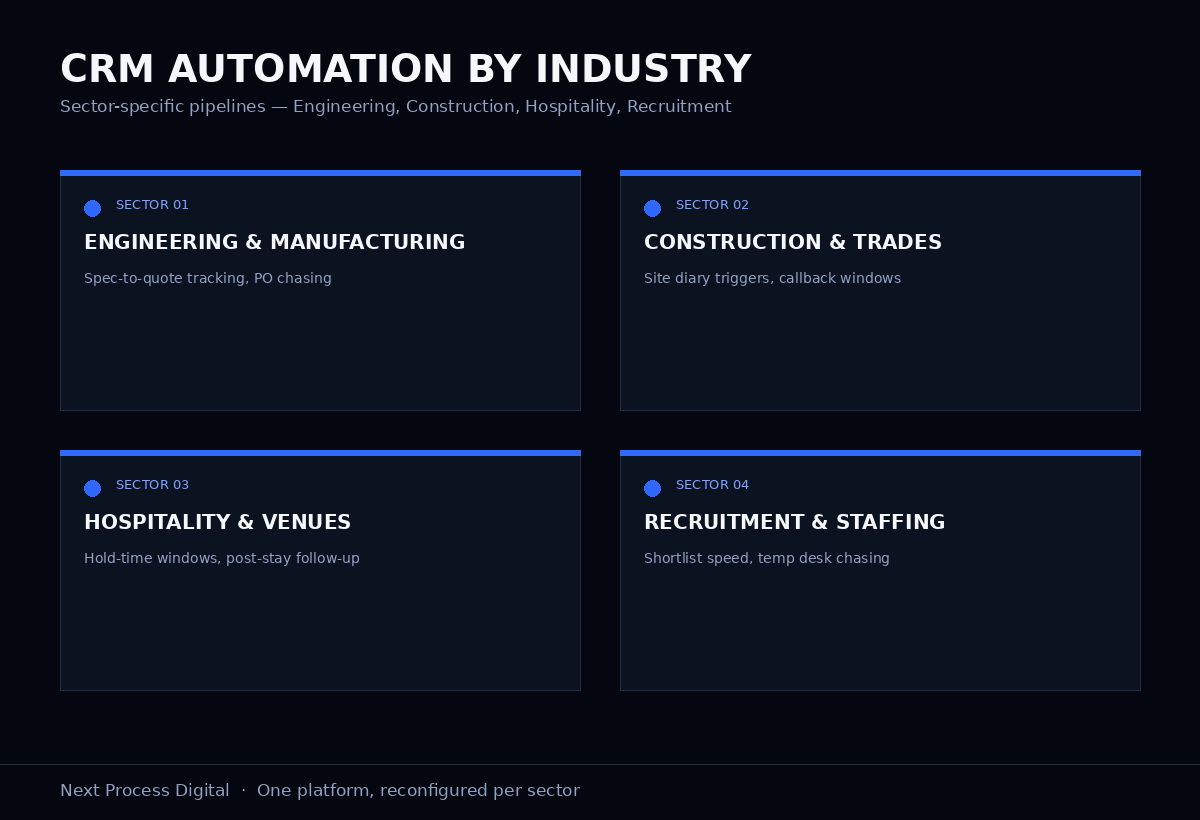
Each of these CRM automation by industry pages below was written from a live client build in that sector — not a keyword brief handed to a copywriter who has never seen the workflow in question.
Spec-to-quote tracking and PO chase-up for firms where the buyer is comparing three suppliers and the fastest accurate quote usually wins the order.
Callback reminders, site-diary triggers and review requests for contractors who lose jobs to a slow reply, not to the standard of the work itself.
Hold-time automation, no-show recovery and post-stay review prompts for venues where a booking left unanswered for an hour is a booking lost.
Shortlist-speed automation and job-order chasing for desks where a ten-minute delay in replying to a candidate hands the placement to a rival agency.
Most “industry” pages are a generic services page with the sector name find-and-replaced in. That approach fails a reader fast, because the pipeline stages described never match how the business in front of them actually operates. Every page in this directory started as a discovery call for a real build, and the wording was drawn from that build rather than from a keyword list — which is what CRM automation by industry should mean in practice. Done properly, the payoff is real: Nucleus Research has tracked CRM returns as high as $8.71 for every $1 spent on well-adopted systems.
Here’s what changes when CRM automation by industry is actually configured around your sector, versus a generic provider running the same template for everyone.
| What’s being compared | Generic automation provider | Next Process Digital |
|---|---|---|
| Discovery call | A form to fill in before on-boarding | A working session that maps your actual pipeline |
| Template reuse | Same stage names across every client site | Stages named and ordered around your sector |
| Escalation path | Routed through a support ticket queue | Direct line to the person who built your system |
| Reporting cadence | A dashboard shipped once and left alone | Reviewed monthly against your sector’s metrics |
| Exit terms | Multi-year lock-in with rollover clauses | No franchise layer, no forced renewal terms |
Swipe to see the full comparison →
A quick check on whether CRM automation by industry — built around your specific sector rather than a generic template — is the right fit for where your business is right now.
Whichever sector you’re in, CRM automation by industry follows the same four-stage build process below — only the configuration inside each stage changes.
We sit with your team to trace exactly where enquiries, jobs or candidates currently stall or fall through, sector context included.
Stage names, automation triggers and escalation rules are drafted around how your specific industry wins and loses work.
The CRM, automations and reporting layer are built, tested against real scenarios and rolled out with hands-on staff training.
Monthly check-ins against the metrics that matter for your sector, with the system adjusted as your business changes shape.
Not usually. These four pages cover where we have the deepest, most repeated delivery history, but the underlying discovery method works for adjacent trades too. A short call is enough to tell you honestly whether it’s a fit before either side commits time.
Yes. The same senior delivery lead who runs your discovery call scopes the build, configures the automations and stays reachable after launch. Nothing is handed off to a separate implementation team partway through.
One platform sits underneath every client. What changes is the configuration — pipeline stages, automation triggers and the reporting layout — so you’re never left maintaining a bespoke tool nobody else understands.
The discovery call maps your actual mix of work rather than forcing everything into a single sector template. Most businesses that span sectors end up with a system that reflects both, configured as one connected pipeline rather than two separate tools.
Price is driven by build scope — the number of pipelines, integration’s and automation rules — not by which of the four sectors you’re in. Configuring the system around your industry doesn’t carry an automatic surcharge.
The team is based in Banbury, Oxfordshire, and works face-to-face with businesses across Banbury, Bicester, Brackley and the surrounding area, plus remotely with clients across the rest of the UK. On the recruitment side specifically, our pipeline stages are built to fit standard practice from the Recruitment & Employment Confederation (REC), the UK’s professional body for the sector — part of what CRM automation by industry means when the industry is recruitment.