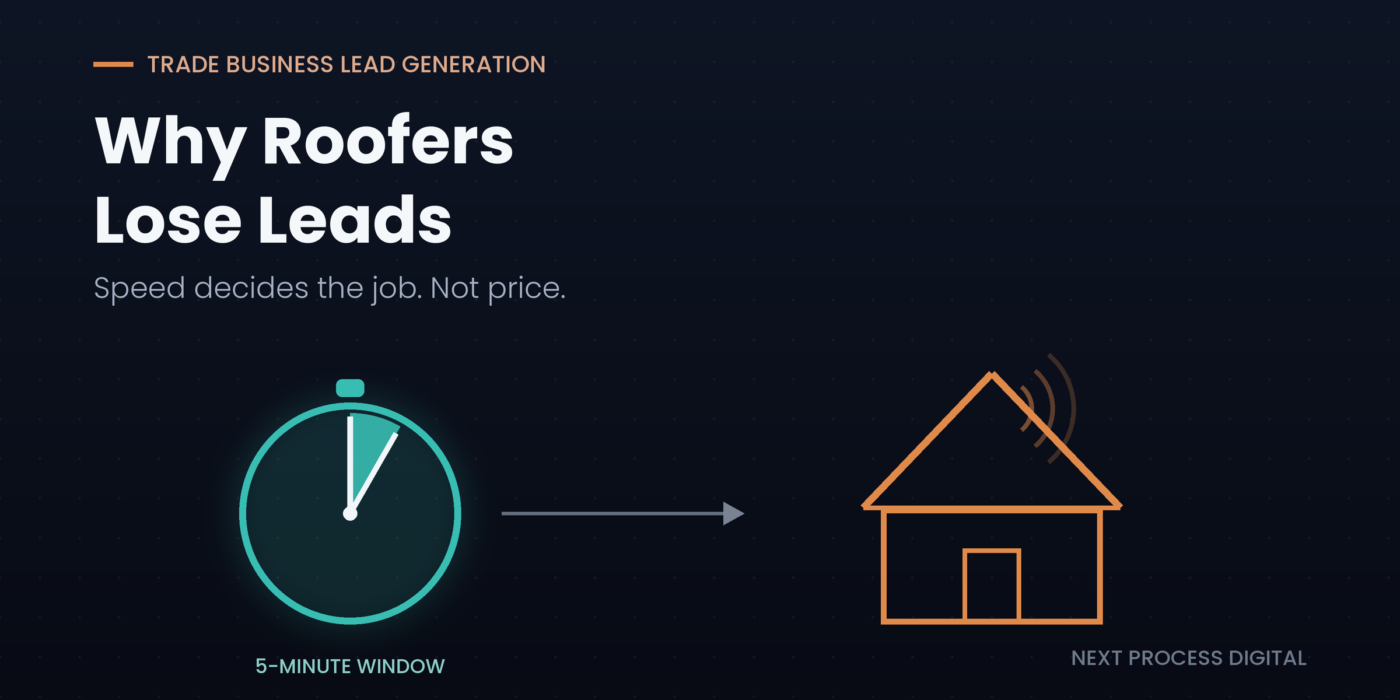
A homeowner’s roof starts leaking on a Tuesday morning. She fills out three contact forms in the space of four minutes — yours and two competitors’. She books with whoever calls back first. Better reviews, a nicer website, twenty years in the trade — none of it matters if you’re the second call she gets. This is why roofers lose leads, and it has almost nothing to do with the quality of the work.
Short answer: most roofing leads aren’t lost on price or workmanship — they’re lost to speed. Homeowners with an urgent roofing problem contact several roofers at once and book with whoever responds first, often within minutes. Roofers lose leads when enquiries sit unanswered for hours between site visits, when quotes go out with no automatic follow-up, and when there’s no system tracking which leads have gone cold. Fixing response speed and follow-up consistently recovers more jobs than any amount of extra ad spend.
Last reviewed 27 July 2026 by wren, who builds websites, CRM and follow-up systems for trade businesses at Next Process Digital and has set up lead-response automation for roofing and construction clients across Oxfordshire and Northamptonshire.
This isn’t just a hunch about how homeowners behave. Industry data compiled by Roofr found that over 40% of roofing leads go to whichever contractor responds first — and that only around 28% of roofers currently use any CRM at all to track their leads. Separately, BrightLocal’s 2025 Local Consumer Review Survey found that 91% of consumers read local business reviews before choosing a company, and most won’t consider one rated below 4 stars. Between them, these two numbers explain most of why one roofer’s phone rings and another’s doesn’t — and neither has anything to do with the actual roofing work.
The Three Places Roofing Leads Actually Die
Understanding why roofers lose leads starts with knowing exactly where enquiries go quiet. They don’t usually disappear all at once. They die in a few specific, repeatable spots:
- After-hours submissions — a homeowner fills in a form at 8pm, the office opens at 8am, and by then two or three competitors have already called back.
- Between-jobs silence — a roofer is up a ladder or driving between quotes, the phone goes to voicemail, and the homeowner moves straight to the next name on their list.
- Warm enquiries with no follow-up — someone asks “for future reference” with no urgency, gets no further contact, and books with whoever eventually does follow up, sometimes weeks later.
None of these require better marketing to fix. They require a system that catches the enquiry the moment it lands and keeps it warm until someone can properly respond — which is a process problem, not a workmanship one.
Why Storm Season Makes This Worse, Not Better
After a storm, enquiry volume can jump five to ten times overnight, and manual call-back capacity simply doesn’t scale to match it. This is exactly when the gap between roofers with a system and roofers without one becomes most visible: firms with automated follow-up in place during a storm surge convert noticeably more of that spike into signed jobs than firms trying to manually call back a suddenly overwhelming list, because the automated ones never let a lead go cold waiting for someone to have a free minute.
Want to see exactly where your enquiries are currently slipping through? Get in touch and we’ll show you.
What Actually Fixes It
Fixing lead loss for a roofing business rarely means spending more on ads. It usually means closing the gap between “enquiry received” and “someone responds,” and making sure nothing warm gets forgotten:
- Instant acknowledgement — an automatic text or email the moment a form is submitted, confirming it’s been received, even before a human calls back
- Missed-call text-back — anyone who calls and doesn’t get through gets an automatic text within seconds, so the enquiry stays alive while you’re on a roof
- Quote follow-up reminders — a nudge if a quote’s gone unanswered for a few days, rather than relying on memory during a busy week
- Review requests after every job — sent automatically once a job’s marked complete, while it’s still fresh, building the review volume that 91% of homeowners are checking before they call
- One system tracking every enquiry — so nothing lives only in a notebook, a shared inbox, or someone’s memory
We’ve seen this pattern play out consistently on roofing and trades desks we’ve worked with: the businesses that close the response gap first are usually fielding noticeably more booked jobs within a few weeks, well before any change in ad spend or workmanship reputation has had time to make a difference.
Quick Reference: Slow-Response Roofer vs. System-Backed Roofer
| Slow-response roofer | System-backed roofer |
|---|---|
| Enquiries answered whenever someone’s free | Instant automatic acknowledgement, every time |
| Missed calls go unanswered until later | Automatic text-back keeps the lead warm |
| Quotes sent with no follow-up | Automatic reminder if a quote goes quiet |
| Reviews requested occasionally, if at all | Requested automatically after every job |
| Storm surges overwhelm manual capacity | Volume spikes handled the same way as any other day |
Where This Connects To CRM
None of this works as a one-off fix — it needs somewhere to live. This is the same territory we’ve covered in our piece on CRM for builders: instant response and follow-up automation only hold up long-term when there’s a system tracking every enquiry through to a won or lost job, rather than living in someone’s head. Roofers who fix response speed without ever tracking the pipeline behind it tend to see the same problem creep back in a few months later.
What This Looks Like For Roofers Around Bicester
Roofing and trade businesses working across Bicester and the surrounding area are usually competing for the same urgent, same-day searches as several other local firms, often for genuinely time-sensitive jobs like storm damage or active leaks. In that environment, being the first to respond — not the cheapest or even the most experienced — is frequently what decides who gets the job. We work with construction and trade businesses across this area to close that response gap properly, rather than patch it with more advertising spend.
Frequently Asked Questions
Is it really speed over price that decides most roofing jobs?
For the initial contact, yes — response speed is consistently the strongest single predictor of who gets called back. Price and reputation still matter once you’re actually talking to the homeowner, but being second to respond often means you never get that conversation at all.
Do we need a big team to respond this fast?
No — most of this is automation, not headcount. Instant acknowledgement and missed-call text-back can run without anyone lifting a phone, buying the time needed for a real callback later in the day.
How much does slow follow-up actually cost a roofing business?
It varies by job value and lead volume, but even a handful of missed jobs a month at typical roofing ticket prices adds up to a meaningful chunk of annual revenue — often more than most roofers would spend fixing the underlying response gap.
Will automated responses feel impersonal to homeowners with an urgent problem?
Not if it’s framed honestly — a quick “we’ve got your message, someone will call you within the hour” reassures rather than annoys. The goal is buying time for a real conversation, not replacing it.
Should we prioritise response speed or getting more reviews first?
Both matter, but response speed usually pays off faster since it directly affects jobs already coming in. Reviews build trust for the enquiries you haven’t won yet, which compounds over a longer timeframe.
What’s the single biggest reason why roofers lose leads that’s easiest to fix?
Missed calls with no follow-up. A simple missed-call text-back costs almost nothing to set up and directly addresses the most common way a warm enquiry goes cold while you’re on a job.
If leads are coming in but jobs aren’t following, the fastest way to find out why is an honest look at how quickly — and how consistently — your business actually responds. Get in touch and we’ll show you exactly where they’re slipping through.