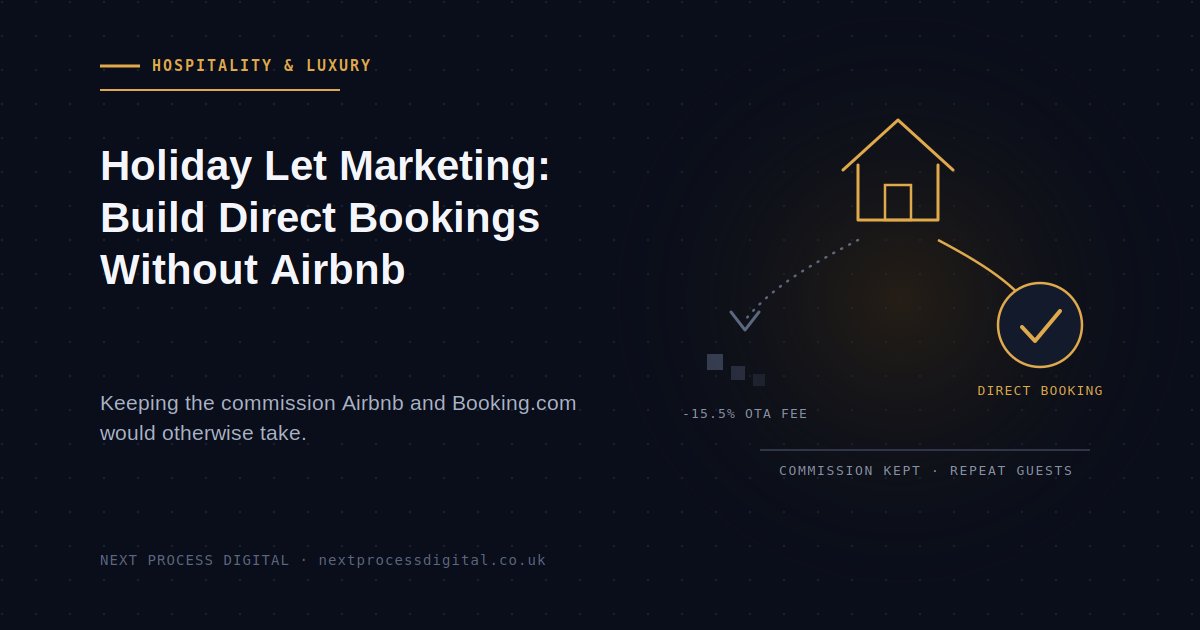

A UK holiday let earning the average £24,700 a year hands over roughly £3,800 of that to Airbnb alone, now that the platform charges a flat 15.5% host fee. Book through Booking.com instead and it’s much the same story, often worse once Preferred Partner and visibility add-ons are factored in. Holiday let marketing that actually builds a direct booking channel is one of the few ways an owner gets to keep that money, rather than handing it to a platform every single stay.
Short answer: holiday let marketing means building enough of your own visibility and guest trust that some bookings come straight to you instead of through an OTA. That means a proper website with real availability and pricing, strong local content, consistent reviews, and a simple way to turn one-time OTA guests into repeat direct bookers. Even shifting a third of your bookings to direct can save well over £1,000 a year in commission on an average UK holiday let, without changing occupancy.
Last reviewed 29 July 2026 by wren, who builds websites and booking systems for hospitality businesses at Next Process Digital and has worked with holiday let and boutique stay owners across Oxfordshire and Warwickshire.
This isn’t just a hunch about platform fees. Research compiled by Travelnest, drawing on the Sykes Holiday Letting Outlook Report, found that Airbnb now charges UK hosts a flat 15.5% fee on every booking, with Booking.com typically similar once optional visibility programmes are included. For a property earning the UK average of £24,700 a year, replacing even half of Airbnb bookings with direct ones was found to save roughly £1,300 annually — without any change in occupancy. That’s not a marginal saving; for most owners it’s close to a month’s income recovered purely by not paying commission on it.
Why Owners Stay Fully Dependent On OTAs
It’s rarely a deliberate choice. Airbnb and Booking.com are genuinely the fastest way to get a new property visible, so most owners start there and never build anything of their own alongside it. The listing does well, bookings come in, and there’s never an obvious moment to stop and build a direct channel — until the annual commission total gets added up.
Once that pattern sets in, it tends to stay. Every guest who books through an OTA is a guest whose email address and phone number the platform keeps, not the owner. There’s no easy way to invite them back directly next time, so even loyal repeat guests keep re-booking through the same commission-charging platform, stay after stay.
Signs A Holiday Let Is Too Dependent On OTAs
- Every booking currently comes through Airbnb or Booking.com, with no direct enquiries at all
- There’s no dedicated website, or one exists but shows no live pricing or availability
- Guest contact details live entirely inside the OTA’s own messaging system
- Repeat guests re-book through the platform rather than contacting the owner directly
- Reviews are strong on the OTA listing but the owner has no presence anywhere else online
None of this means OTAs should be abandoned — they remain a genuinely useful source of new guests who’d never otherwise find a smaller property. The issue is when they’re the only channel, because that means paying commission on 100% of bookings indefinitely, including the repeat guests who’d happily book direct if there were an easy way to.
Picture a two-bedroom Cotswolds cottage earning close to the UK average, fully dependent on Airbnb. Roughly £3,800 a year goes straight to commission, including on the family who’s stayed three times already and would happily book again without ever touching the app if they simply had a way to. A basic direct booking page with live availability, offered to that family after their second stay, is often all it takes to convert them — and every future booking from them afterwards costs nothing beyond card processing fees.
Want to see what a direct booking channel would realistically look like for your property? Get in touch and we’ll show you.
What Actually Builds Direct Bookings
- A proper booking-capable website — live availability and real pricing, not a brochure page that sends people back to the OTA to actually book
- Local content beyond the property itself — walks, restaurants, attractions nearby, capturing guests still deciding on a destination, not just a specific property
- A reason to book direct — even a small perk (late checkout, a welcome hamper, a marginally better rate) gives a guest comparing options an actual reason to skip the OTA
- Consistent reviews across platforms — not just on the OTA listing, but on Google, where guests searching for the destination directly will find you
- A simple way to invite past guests back — an email after checkout with a direct booking incentive for next time, rather than letting the OTA own that relationship permanently
Quick Reference: OTA-Only vs. Blended Booking Strategy
| OTA-only | Blended direct + OTA |
|---|---|
| 15-18% commission on every single booking | Commission only on OTA-sourced bookings |
| No guest contact details retained | Guest details captured for repeat direct bookings |
| Repeat guests still cost full commission | Repeat guests invited to book direct, commission-free |
| Visibility depends entirely on platform algorithm | Own website ranks independently for destination searches |
| Reviews live only on the OTA | Reviews build trust across Google and the owner’s own site |
Where This Connects To Everything Else
A direct booking channel only works if it’s genuinely easy to use once someone lands on it — the same principle covered in our piece on hotel SEO and OTA dependency. Whether it’s a boutique hotel or a single holiday cottage, the underlying problem is the same: visibility and booking ease need to work together, or guests default back to the platform that makes booking simplest, even if it costs the owner more.
If your property also hosts weddings or events, the same commission-avoidance logic applies there too — see our companion piece on Wedding Venue Marketing.
What This Looks Like For Holiday Lets Across The Region
Holiday let owners across Banbury, Chipping Norton, Woodstock, and Stratford-upon-Avon are typically competing with dozens of similar Cotswolds and countryside properties listed on the same two or three platforms. In that environment, a proper direct channel — even a modest one — is one of the only ways to stop paying full commission on every single stay indefinitely. We work with hospitality businesses across this region to build exactly that kind of blended booking strategy, without abandoning the OTA visibility that still brings in genuinely new guests.
Frequently Asked Questions
Should we come off Airbnb and Booking.com entirely?
Usually not. They remain a strong source of first-time guests who’d never otherwise find the property. The goal is adding a direct channel alongside them, not replacing them outright.
How much does it cost to set up a direct booking website?
It varies by scope, but for a single property or small portfolio it’s typically a modest one-off cost that pays for itself within the first year through commission saved on just a handful of direct bookings.
Will guests actually book direct if they can just use Airbnb?
Many will, particularly repeat guests, if there’s a genuine reason to — a slightly better rate, direct communication, or simply because they already trust the property. First-time guests are harder to convert direct, which is exactly why OTAs remain useful for that stage.
Do we need a booking system, or is an enquiry form enough?
Live availability and instant booking convert far better than an enquiry form, since guests comparing several properties rarely wait around for a reply before booking somewhere else that lets them book instantly.
What’s the single best place to start with holiday let marketing on a limited budget?
A basic direct booking page with real availability and pricing, paired with an email to past guests after checkout inviting them back. Both are low-cost, and both target the guests already most likely to book direct — people who already trust the property.
If OTA commission is quietly eating into every booking, the fastest way to start recovering it is a proper look at what a direct channel would look like for your property. Get in touch and we’ll show you what’s realistic to build first.