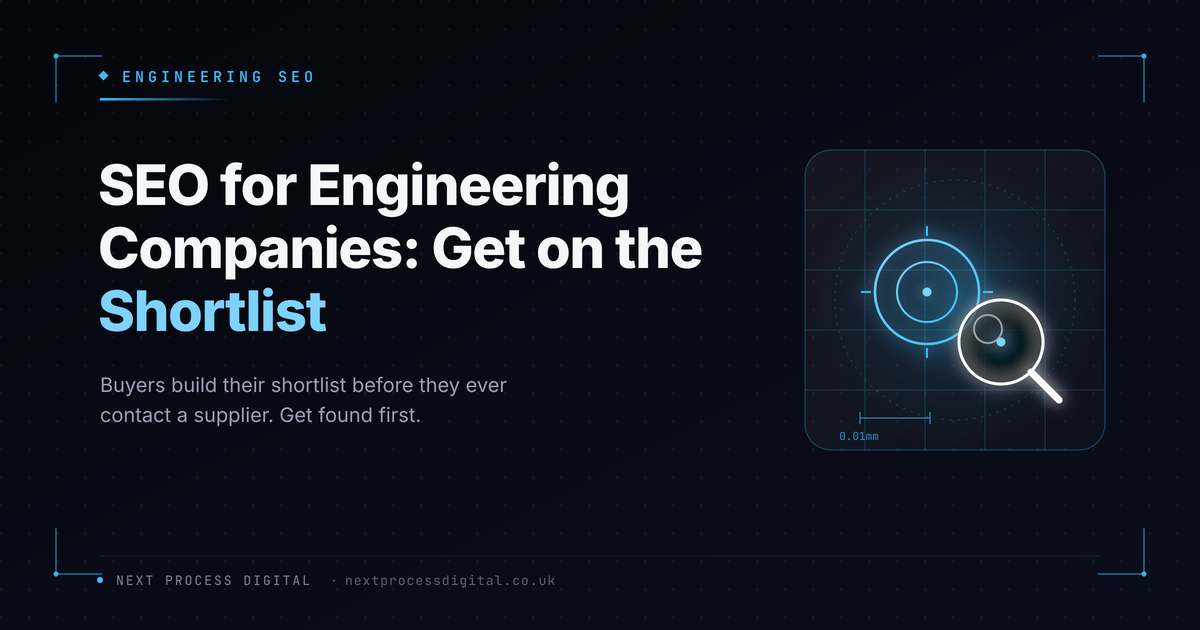
A procurement engineer at a manufacturing firm needs a new supplier. They don’t ask around first. They search — “CNC machining tolerances Brackley,” “precision fabrication supplier Oxfordshire” — and build a shortlist from what comes back. By the time anyone picks up the phone, most of the decision is already made. SEO for engineering companies is what determines whether your firm is even part of that search.
Short answer: SEO for engineering companies means ranking for the specific technical, capability, and location searches procurement teams actually run. It means backing that up with content that proves real capability, not generic “quality engineering solutions” copy. Buyers now do most of their supplier research independently, before contacting anyone. If your site isn’t visible and credible at that stage, you’re often eliminated before you ever hear about the enquiry.
Last reviewed 4 August 2026 by wren, who builds SEO, CRM and automation systems for engineering and manufacturing businesses across Oxfordshire and Northamptonshire.
If your site isn’t showing up for the searches buyers are already running, that’s usually fixable fast — book a free strategy call or call +44 7498 897007.
In This Guide
- Why SEO for engineering companies works differently to most B2B sectors
- Signs your engineering website is losing enquiries at the shortlist stage
- What makes SEO for engineering companies different from generic SEO
- What SEO for engineering companies should actually deliver
- What this costs and how long it takes
- A real example: what being invisible at the shortlist stage costs
- What realistic results look like
- Why this matters around the Brackley and Silverstone corridor
- Frequently asked questions
Why SEO For Engineering Companies Works Differently To Most B2B Sectors
Modern industrial buying is a slow, committee-driven process. Research from 6sense’s 2025 Buyer Experience Report found that buying groups now average ten or more stakeholders on deals of this size. The same research found that 95% of purchases go to a vendor who was already on the buyer’s shortlist from day one.
That shortlist gets built almost entirely without you in the room. Separate analysis of Gartner’s B2B time-allocation research found that buyers spend around 27% of their total buying time on independent research, against just 5 to 6% actually meeting any single vendor. That’s a five-to-one ratio in favour of research you never see happening.
And it starts even earlier than most firms assume. Industry-wide survey data reported by The SEO Works found that 92% of B2B buyers already start their research with at least one specific vendor in mind, built entirely from what they found online beforehand.
In other words, an engineering firm doesn’t lose most quote opportunities in the quoting stage. It loses them earlier, at the shortlist stage, to whichever supplier’s website answered the technical question a buyer was searching for.
Signs Your Engineering Website Is Losing Enquiries At The Shortlist Stage
A handful of patterns tend to show up together in engineering and manufacturing firms that are quietly missing shortlist-stage traffic:
- The site has one general “engineering services” or “about us” page instead of separate pages for each real capability
- Copy leans on adjectives like “high quality” and “industry-leading” instead of tolerances, certifications, and materials
- There’s no page that would rank for a specific process-plus-location search a procurement engineer might type
- Case studies are missing, or too vague to show a real material, tolerance, or timeline
- Enquiries land in a shared inbox with no system tracking which one came from where, or who followed up
None of this reflects the quality of the actual engineering work. It reflects whether the site was built to answer the specific, technical questions a buyer was already searching for before they ever considered picking up the phone.
What Makes SEO For Engineering Companies Different From Generic SEO
Most SEO advice is written for retail or simple service businesses. Engineering search behaviour doesn’t look like that at all.
Buyers search by specific capability, not by broad category. “CNC machining” is too generic to matter much. “5-axis CNC machining tolerances 0.01mm” is exactly the kind of specific, technical phrase a real buyer types when they already know what they need. A generic “precision engineering services” page never ranks for that. A page built around the actual capability does.
Buyers also want proof, not adjectives. “High quality,” “industry-leading,” and “trusted partner” are the same three phrases on every competitor’s homepage. What actually differentiates a page is real evidence: certifications, materials worked with, tolerances held, case studies with specifics, and equipment lists a technical buyer can actually evaluate.
Generic Engineering Website vs. One Built For How Buyers Actually Search
| Area | Generic Engineering Website | Built For Real Buyer Searches |
|---|---|---|
| Page focus | One broad “engineering services” page | Separate pages per capability, material, and tolerance |
| Language | “High quality,” “industry-leading” | Specific tolerances, certifications, materials |
| Proof | Stock photos of machinery | Real case studies with named outcomes |
| Local visibility | No mention of location or corridor | Ranks for “[capability] + [town]” searches |
| Enquiry handling | Generic contact form | Tracked in a CRM built around long, technical sales cycles |
What SEO For Engineering Companies Should Actually Deliver
1. Capability pages built around real technical searches
Instead of one generic services page, separate pages for each real capability — specific processes, materials, and tolerances — matched to the exact phrases a procurement engineer would search.
2. Case studies with real, specific outcomes
Not “we delivered excellent results,” but a real project: the material, the tolerance held, the timeline met. This is also what Google’s E-E-A-T guidelines are looking for — evidence of genuine experience, not just claims of it.
3. Local and industrial-corridor visibility
Firms based in industrial estates and motorsport-adjacent supply corridors benefit from content that reflects that context directly. That way, a search combining a capability with a nearby town or business park returns your site, not a national directory listing.
4. A CRM built for long, multi-stakeholder sales cycles
SEO gets a buyer to your site. What happens after they enquire matters just as much. A CRM system built around engineering sales cycles tracks a quote through revisions and multiple stakeholders, instead of letting a promising enquiry go quiet in a shared inbox.
What This Costs And How Long It Takes
Most engineering and manufacturing firms budget for this as either a capability-page rebuild plus an ongoing SEO and content retainer, or a smaller initial project — a handful of priority capability pages and case studies — with the rest phased in over time. Cost depends mainly on how many distinct capabilities, certifications, and existing case studies there already are to work with, since that’s what determines how many pages actually need building.
Building out a first set of capability and case study pages typically takes four to eight weeks. Local and capability-specific visibility can begin shifting within a couple of months of that content going live, but ranking consistently for competitive technical terms against established competitors in the same corridor usually takes six months or more of consistent, specific content.
A Real Example: What Being Invisible At The Shortlist Stage Costs
Picture two precision engineering firms with genuinely comparable capability. One has a generic “about us and our services” website, last meaningfully updated years ago. The other has separate pages for its actual processes, named certifications, and a handful of real project write-ups.
A procurement engineer searching for a specific capability finds the second firm. The first firm never shows up in that search at all. Not because their work is worse — because nothing on their site matched what was actually typed into Google.
That’s the pattern behind most “we don’t get enough enquiries” complaints we hear from engineering firms. The work is usually fine. The website simply isn’t built to be found by the specific searches buyers are already running.
What Realistic Results Look Like
Because engineering procurement decisions run through a long, multi-stakeholder process, the earliest signal usually isn’t a jump in enquiries — it’s more qualified enquiries arriving already knowing roughly what your firm can do, because they found the specific capability page that answered their question. That shift tends to show up within the first couple of months of new capability pages going live.
Broader ranking movement against established competitors builds more slowly, typically over three to six months, and compounds as more capability, material, and case study pages earn authority. Firms that treat this as an ongoing programme rather than a one-off project tend to keep extending their visibility as new capabilities, certifications, and projects get added.
Why This Matters Around The Brackley And Silverstone Corridor
This area has an unusually dense concentration of precision engineering, CNC machining, and motorsport supply firms, many competing for the same pool of tier-one and tier-two contracts.
In a corridor with this much specialist competition, ranking for the specific capability searches buyers run — rather than a generic regional keyword — is what actually separates firms that get found from firms that don’t.
For the service itself, see our SEO services page, for the wider engineering and manufacturing sector our Engineering & Manufacturing industry page, and for the local business landscape our Brackley location page. For related reading, see our companion pieces on CRM for Engineering Companies and Why Engineering Websites Fail.
Book a free strategy call: get in touch online or call +44 7498 897007 to see how your firm currently shows up for the searches buyers are actually making.
Frequently Asked Questions
How is SEO for engineering companies different from SEO for a typical local business?
Engineering buyers search by specific technical capability, not broad category. They also evaluate a site based on real proof of capability rather than generic marketing language, which means the content strategy has to be far more specific than most local SEO work.
We rarely hear about lost enquiries. How would we know SEO is a problem?
That’s exactly the risk. If a buyer never finds your site during their research, you never appear as a missed enquiry — you simply never existed in that buyer’s process at all.
Do case studies actually affect rankings, or are they just for buyers?
Both. Specific, evidenced case studies satisfy Google’s expectation of genuine, demonstrated experience. They’re also exactly the kind of proof a technical buyer is looking for when comparing suppliers.
How long does SEO for engineering companies take to show results?
Local and capability-specific visibility can begin shifting within a couple of months. Ranking consistently for competitive technical terms against established competitors typically takes six months or more of consistent, specific content.
What’s the fastest thing to fix first?
Usually the highest-value capability pages that don’t exist yet — the specific processes and tolerances buyers are already searching for but can’t find on your site. New content on a real capability tends to move faster than trying to out-rank competitors on a broad, generic term.
Is this worth it for a smaller engineering or fabrication firm?
Often more so than for a large firm. A smaller shop competing purely on reputation and word of mouth has the most to gain from being found by buyers who don’t already know it exists.
If your firm isn’t showing up for the specific searches buyers are actually making, get in touch or call +44 7498 897007 and we’ll show you exactly what’s realistic to fix first.