A quote goes out for a CNC job on a Tuesday. The buyer said they’d decide by Friday. Nobody puts a reminder anywhere, because there’s no anywhere to put it — just an email sent from someone’s inbox and a mental note to “follow up later.” Friday comes and goes. The following week, someone finally remembers to chase it, only to find the buyer placed the order with a competitor three days earlier — the one who called back first. This happens in engineering and manufacturing businesses every single week, and it’s rarely down to price or capability. It’s down to the fact that nobody had a system tracking who owed who a follow-up.
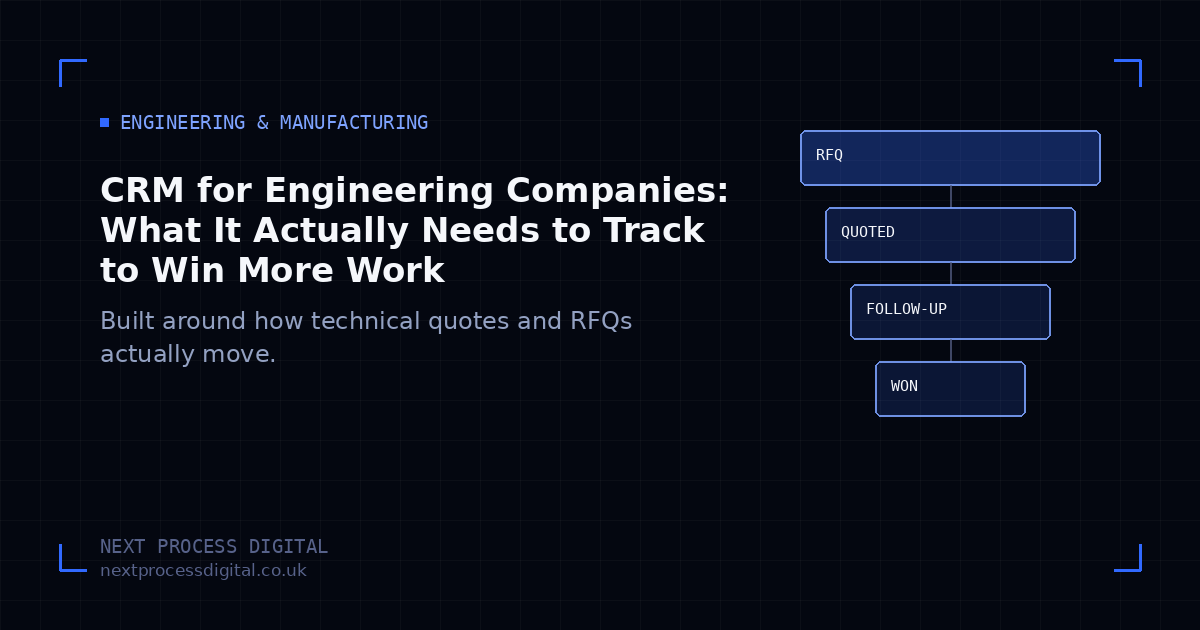
This is exactly the gap a proper CRM for engineering companies is supposed to close. Not a generic contact database bolted on because someone read it was good practice — a system built around how technical quotes, RFQs and long sales cycles actually move through your business.
Short answer: a CRM for engineering companies needs to capture every enquiry in one place, track quotes through revisions, assign an owner automatically, trigger follow-up reminders, hold multiple technical contacts per account, and report win rate by quote type. Off-the-shelf CRM platforms already do most of this — what most engineering firms are missing is configuration around their actual quoting process, not different software.
Last reviewed 23 July 2026 by wren, who builds CRM and automation systems for engineering, trade and hospitality businesses at Next Process Digital and has configured quote-based pipelines for precision engineering and fabrication clients across Oxfordshire and Northamptonshire.
This isn’t just a hunch about how buyers behave. Research published in the Harvard Business Review by Oldroyd and McElheran, drawing on over 100,000 sales contact attempts across more than 2,000 companies, found that firms trying to reach a new enquiry within an hour were roughly seven times more likely to have a meaningful conversation with the buyer than those who waited even one hour longer — and that for web-generated enquiries specifically, the large majority of business goes to whichever supplier responds first. Engineering quotes move slower than a typical retail enquiry, but the underlying pattern holds: the supplier who gets back to the buyer first usually shapes the conversation, quite apart from who eventually wins on price or capability.
Why Generic CRM Advice Doesn’t Fit Engineering Sales
Search for CRM advice and you’ll mostly find software comparison lists: Salesforce versus HubSpot versus Pipedrive, ranked by price and feature count. That’s fine if you’re selling a simple product with a short sales cycle. It’s the wrong frame entirely for an engineering or manufacturing business.
A retail CRM tracks “contact made contact bought.” An engineering sales cycle looks nothing like that. A single opportunity might involve an initial enquiry, a technical drawing review, a revised quote after a spec change, a site visit, a second revised quote, and a decision that takes three months — with two or three people on the buyer’s side involved at different stages. Generic CRM guides don’t account for any of that, because they’re written for businesses where the sale is a single conversation, not a technical negotiation spread across a quarter.
That mismatch is why so many engineering firms try a CRM once, find it doesn’t fit how they actually sell, and go back to a shared inbox and a spreadsheet. Research on CRM rollouts in manufacturing backs this up directly — analysts at Forrester have identified low user adoption, not the software itself, as the leading cause of failed CRM implementations, and manufacturing-sector deployments fail for the same root reason: the tool gets set up around a generic “lead → opportunity → deal” model instead of the RFQ-and-revision process the sales team actually runs. The problem usually isn’t the software — it’s that nobody configured it around a quote-based sales process before rolling it out.
If your enquiries currently live across email, a spreadsheet and someone’s memory, get in touch and we’ll walk through what a system built around your actual quoting process would look like.
What a CRM for Engineering Companies Actually Needs to Do
Strip away the software marketing and a CRM for an engineering or manufacturing business needs to do a fairly short list of things well:
- Capture every enquiry in one place — whether it comes from a website form, a phone call, an email or a trade contact, it should land in the same system rather than three different inboxes.
- Track quotes through revisions — not just “quote sent,” but which version is live, what changed between revisions, and what the buyer actually asked to change.
- Assign ownership automatically — every live enquiry needs one named person responsible for it, so nothing sits unanswered because everyone assumed someone else had it.
- Trigger follow-up reminders — if a quote has been sitting for five days with no response, the system should flag it, not rely on someone remembering.
- Hold technical contact detail — who the procurement contact is versus the technical reviewer versus the final decision-maker, since engineering sales rarely involve just one person on the other side.
- Report on win rate by quote type — so you can see, for example, that fabrication quotes convert at a very different rate to CNC quotes, and adjust where you spend time chasing accordingly.
None of this is complicated in principle. What’s missing in most engineering firms isn’t the willingness to do it — it’s that nobody built the system to do it automatically. When follow-up depends on someone remembering, it eventually stops happening, especially during a busy quarter when the same people are also trying to run live projects.
A pattern we see repeatedly when we take on a new CRM build for an engineering client: the enquiries were never actually being lost at the quoting stage — they were being lost in the gap between “quote sent” and “someone remembers to chase it.” On one subcontract manufacturing client we onboarded earlier this year, roughly a third of open quotes had gone more than ten days without a single follow-up touch before the reminder workflow was switched on. Once ownership and reminders are automatic rather than dependent on memory, that gap closes on its own, without anyone having to change how they price or how they work.
CRM for Engineering Companies vs. a Generic Small Business CRM
| What’s being tracked | Generic small business CRM | CRM configured for engineering companies |
|---|---|---|
| Sales cycle shape | Single conversation, one decision point | Enquiry → drawing review → revised quote(s) → site visit → decision, over weeks or months |
| Contacts per account | Usually one | Procurement contact, technical reviewer and final decision-maker tracked separately |
| Quote handling | “Quote sent” as a single status | Versioned revisions, each linked to the spec change that triggered it |
| Follow-up logic | Manual, ad hoc | Automatic reminder windows (typically 3–5 working days), with escalation |
| Reporting | Overall win rate | Win rate broken down by quote type (CNC, fabrication, assembly, etc.) |
The Platform Matters Less Than the Configuration
We’re not tied to one CRM platform, and if anyone tells you there’s a single “best CRM for engineering companies” regardless of your size, team and process, treat that with some scepticism. A five-person precision engineering shop and a fifty-person subcontract manufacturer need very different levels of complexity. What matters far more than the brand name on the login screen is whether the system has been configured around your actual quoting process — your pipeline stages, your revision workflow, your follow-up windows — rather than left on its factory-default settings.
This is where a lot of CRM rollouts quietly fail. A business buys a well-reviewed platform, imports a spreadsheet of contacts, and stops there. Nobody builds the pipeline stages around how quotes actually move from enquiry to won or lost. Nobody sets up the automatic reminders. Six months later, the CRM has become an expensive contact list, and the team is back to chasing quotes from memory because the system never matched the way they actually sell. This is also why we scope CRM and automation work around the sales process first and the software choice second — the platform is the easy decision; the pipeline design is the part that actually determines whether it gets used.
Quick Reference: What Should Happen at Each Stage
| Sales stage | What a properly configured CRM should do |
|---|---|
| Enquiry received (web form, call, email) | Logged automatically, assigned to an owner within minutes, not hours |
| Initial quote sent | Follow-up reminder set for a defined window — typically 3–5 working days |
| Spec change or revision requested | New quote version linked to the original, so nobody works from an outdated figure |
| No response after follow-up window | Second reminder triggers automatically, escalated if still unanswered |
| Quote won or lost | Outcome logged against quote type, so win-rate data builds up over time |
Ready to see what this looks like configured around your own quoting process? Get in touch and we’ll show you exactly where your current process is leaking quotes.
What This Looks Like for Engineering Firms Around Banbury
Banbury’s industrial estates — Wildmere Road, Cherwell Business Village, Thorpe Mead — are home to a genuine mix of precision engineering, fabrication and subcontract manufacturing businesses, many of them competing for work from the same handful of larger buyers in the wider Oxfordshire and Northamptonshire corridor. In that kind of market, the firm that responds to an RFQ within a day rather than a week has a real edge, independent of who actually has the better price or capability.
Most of these businesses aren’t losing quotes because their engineering is weak. They’re losing them because a quote sat in someone’s inbox for four days while that person was tied up on the shop floor, and the buyer moved on before anyone got back to them. A CRM configured around exactly that risk — automatic assignment, follow-up reminders, revision tracking — fixes a problem that has nothing to do with engineering capability and everything to do with process. We work with engineering and manufacturing businesses across Banbury and the surrounding area on exactly this: a website and enquiry system that feeds a CRM built around how your quotes actually move, not a generic template lifted from a software vendor’s demo. If you’d rather see how the same thinking applies outside engineering, our piece on CRM for builders covers the equivalent problem for quote-based trade businesses, and our automation for trade businesses article covers the follow-up side in more depth.
Frequently Asked Questions
Do we need a CRM if we already use a spreadsheet to track quotes?
A spreadsheet works until more than a handful of quotes are live at once. Past that point, nothing reminds anyone to follow up, revisions get overwritten, and there’s no easy way to see what’s actually converting. A CRM does the same job but automatically, and keeps a history you can act on.
What’s the difference between a CRM for engineering companies and a generic small business CRM?
Most generic CRMs assume a short sales cycle with one contact and one decision point. Engineering sales usually involve multiple contacts, quote revisions and a decision that takes weeks or months. The difference isn’t the software — it’s how the pipeline stages, fields and reminders are configured.
How long does it take to set up a CRM properly for an engineering business?
It depends on how many quote types and stages your business runs, but most engineering firms can have a working system — enquiry capture, pipeline stages, follow-up reminders — live within a few weeks, with refinements added once the team is using it day to day.
Can a CRM integrate with our existing quoting or accounting software?
In most cases, yes. The CRM platforms we work with connect natively with email, calendars and common accounting software, and where a native integration doesn’t exist, tools like Zapier or Make usually bridge the gap without custom development.
Will our team actually use a CRM, or will it end up ignored like the last one?
Adoption is the real risk with any CRM, not the software itself. Systems get ignored when they’re configured to add admin rather than remove it. Built properly — automatic capture, minimal manual data entry, reminders that actually help rather than nag — a CRM should make the team’s week easier, not longer.
Do we need a CRM if we’re a small engineering firm with just a handful of live quotes at any time?
If every quote is currently tracked reliably in someone’s head with nothing ever slipping, you may not need one yet. Most small firms are surprised how often something does slip once they start counting.
Which CRM platform is best for an engineering or manufacturing business?
There isn’t one universal answer — HubSpot, Pipedrive and specialist manufacturing CRMs all work well when they’re configured correctly, and all fail the same way when they’re not. We generally recommend choosing a platform based on what your team already knows and what it needs to integrate with, then investing the real effort in configuring the pipeline stages, quote-revision tracking and reminder windows around your process, rather than shopping for a platform with a “manufacturing” label on the box.
How do we measure whether our CRM is actually working?
Track two numbers before and after: average time from enquiry to first response, and the percentage of quotes with a logged outcome (won or lost) rather than sitting open indefinitely. If response time drops and open-but-abandoned quotes fall close to zero, the system is doing its job. Win-rate-by-quote-type data becomes useful once you have a few months of consistent logging behind it.
What does it cost to get a CRM configured properly for an engineering business, versus buying the software alone?
The software licence itself is usually the smaller cost. The bulk of the value — and the bulk of the work — is in configuring pipeline stages, quote-revision tracking and reminder logic around your specific process, which a generic setup or self-service onboarding rarely covers properly.
If quotes are currently living across email, a shared inbox and a spreadsheet, the fastest way to find out what’s actually falling through is an honest look at your current process. Get in touch and we’ll show you what a CRM built around your quoting process would actually look like — and what it would take to set one up properly.