A couple finds a wedding venue on Instagram, falls in love with the photos, clicks through to the website, and can’t find a straightforward way to check availability or request a viewing. They move to the next venue on their shortlist within minutes. That is exactly where a wedding venue follow-up process earns its keep — catching the enquiry the moment it lands, and keeping the couple warm until they book. UK couples spent an average of £20,604 on their wedding in 2026, according to Bridebook’s UK Wedding Report, based on a survey of around 7,000 couples — and that’s before the ring or honeymoon. That’s not a small missed enquiry; it’s one of the highest-value leads most hospitality businesses will ever lose to friction alone.
Short answer: a good wedding venue follow-up system means acknowledging every enquiry instantly, tracking each couple through a long, multi-venue decision process, and following up on a schedule so nothing goes cold. Miss any one piece and high-value enquiries quietly go to a competitor instead.
Last reviewed 11 August 2026 by wren, who builds SEO, CRM and websites for hospitality and luxury venues across Oxfordshire and Warwickshire.
If enquiries are landing but not converting into booked viewings, that’s usually fixable fast — book a free strategy call or call +44 7498 897007.
If you haven’t yet nailed the discovery stage — ranking for the right searches, real photography, transparent pricing — start with our companion guide, Wedding Venue Marketing: Win the Shortlist. This piece picks up from there: what a solid wedding venue follow-up process looks like once the enquiry actually lands.
In This Guide
- Why wedding venue follow-up is its own discipline
- Signs your venue is losing enquiries before the viewing
- What a wedding venue follow-up process should actually cover
- Where marketing meets CRM and wedding venue follow-up
- Generic hospitality marketing vs. built for wedding venues
- What this costs and how long it takes
- What realistic results look like
- Why this matters around Chipping Norton, Woodstock and Stratford-upon-Avon
- Frequently asked questions
Why Wedding Venue Follow-Up Is Its Own Discipline
A wedding is one of the most emotionally significant purchases a couple will ever make, and it’s usually decided by two people comparing several venues over weeks or months — shortlisting online, visiting a handful in person, and picking the one that felt right. That combination of high emotional stakes, long consideration and multiple decision-makers makes wedding venue follow-up meaningfully different from following up a hotel room or a holiday let enquiry, where the purchase is far more transactional.
Couples search visually and specifically — “barn wedding venue Cotswolds,” “marquee wedding venue Oxfordshire availability 2027” — and they judge how a venue follows up almost as critically as the venue itself. A slow reply, a generic email, or no clear next step is often enough to lose the enquiry before a single viewing is booked.
Signs Your Venue Is Losing Enquiries Before The Viewing
A handful of patterns tend to show up together in venues with a weak wedding venue follow-up process:
- The website looks beautiful but there’s no clear way to check date availability or request a viewing
- Enquiry forms ask for more detail than a couple is ready to give this early in their search
- Photography is dated, or doesn’t show the venue dressed for an actual wedding
- The site ranks for the venue’s name but not for the specific searches couples make when comparing options
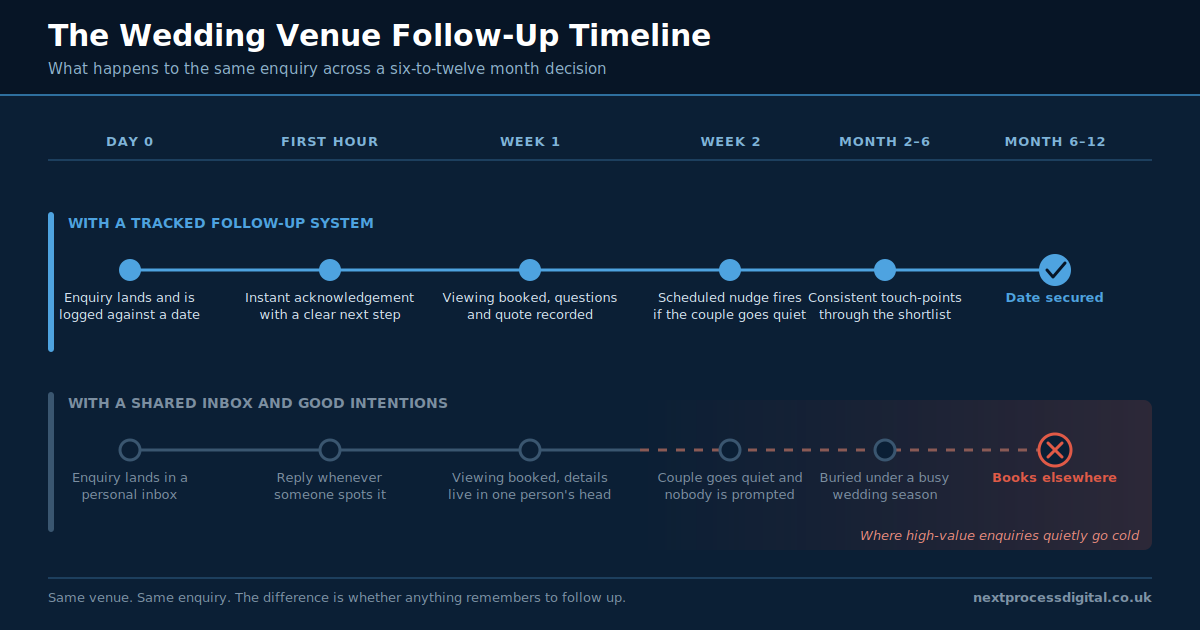
- Enquiries land in a personal inbox with no system tracking which couples were followed up, and when
None of this reflects how special the venue actually is. It reflects whether the wedding venue follow-up experience matches the emotional weight of the decision a couple is trying to make.
What A Wedding Venue Follow-Up Process Should Actually Cover
1. Ranking for how couples actually search
Specific, descriptive search terms — by style, capacity, location and season — rather than generic “wedding venue” terms with enormous national competition and little local relevance.
2. A website built around the emotional decision, not just information
Real photography, real couples’ experiences, and a clear, simple way to check availability and request a viewing — removed of any unnecessary friction at the exact moment a couple is most interested.
3. Fast, low-friction enquiry capture
A short initial enquiry form that asks only what’s needed to start a conversation, not a lengthy questionnaire that feels like paperwork before the couple has even seen the venue in person — the first step of any good wedding venue follow-up sequence.
4. Direct booking visibility alongside third-party listings
Wedding directories bring valuable traffic, but venues that rely on them exclusively hand over both the enquiry and, often, a commission — a venue’s own site needs to rank and convert independently too.
Where Marketing Meets CRM And Wedding Venue Follow-Up
Getting the enquiry is only half the job. Couples are almost always comparing several venues at once, over a decision period that can run for months, and the venue that stays warm and responsive tends to win the booking — not necessarily the one that impressed them most on the first viewing.
This is where a proper CRM system matters as much as the marketing itself. Every enquiry needs to be logged, assigned, and followed up on a schedule, with viewing dates, questions asked and quotes sent all visible in one place — not scattered across a shared inbox where a promising couple can quietly slip through. Layering in marketing automation on top means a couple who enquires gets an immediate response, a scheduled nudge if they’ve gone quiet after a viewing, and a consistent touch-point through what’s often a six-to-twelve-month decision — without relying on someone remembering to follow up during a busy wedding season.
Generic Hospitality Marketing vs. Built For Wedding Venues
| Area | Generic Hospitality Marketing | Built For Wedding Venues |
|---|---|---|
| Keyword targeting | Broad “wedding venue” terms | Style, capacity, season and location-specific terms |
| Website purpose | Informational brochure | Built around the emotional decision and availability |
| Enquiry handling | Shared inbox, ad hoc follow-up | CRM-tracked wedding venue follow-up with a set schedule |
| Booking channel | Reliant on wedding directories | Direct enquiries alongside directory traffic |
| Decision-period follow-up | One-off contact after the viewing | Consistent touch-points across months |
Picture two similar venues in the same area. One relies entirely on directory listings and a static website with a basic contact form. The other ranks for the specific searches its ideal couples make, converts viewing requests through a simple, fast enquiry path, and keeps every couple warm through a proper wedding venue follow-up sequence. A year later, the second venue has secured more of its prime dates — not because it’s a more beautiful venue, but because fewer enquiries were lost to friction or forgotten follow-up.
What This Costs And How Long It Takes
Most venues budget for this as either a website rebuild with CRM integration as a one-off project, plus an ongoing retainer for SEO and content, or a smaller initial setup with wedding venue follow-up automation added once the CRM is bedded in. Cost depends mainly on how much of the groundwork — professional photography, real couple testimonials, existing content — already exists.
A rebuilt, conversion-focused website with CRM integration typically takes six to ten weeks. Meaningful SEO movement generally takes three to six months, though fixing the enquiry-to-viewing conversion path can show a difference within weeks, since it improves what happens to traffic you’re already getting.
What Realistic Results Look Like
Because wedding bookings are decided months or even a year or more in advance, the clearest early signal is usually an increase in viewing requests and a drop in enquiries that go quiet without explanation — both of which tend to improve within the first couple of months once the enquiry path and wedding venue follow-up system are fixed. Organic search visibility builds more slowly, typically over three to six months, but compounds as more style, capacity and season-specific pages earn authority.
This sits alongside the wider hospitality picture covered in our Hospitality content, including our companion pieces on Hotel SEO and Holiday Let Marketing — the same principles of visibility, conversion and follow-up apply across hospitality, just tuned to a very different buying decision.
Why Wedding Venue Follow-Up Matters Around Chipping Norton, Woodstock And Stratford-upon-Avon
The Cotswolds and wider Warwickshire corridor around Chipping Norton, Woodstock and Stratford-upon-Avon is one of the UK’s most searched-for wedding destinations, which cuts both ways — genuine demand, but also genuine competition from well-established venues with strong existing visibility. Standing out here means being specific: the venues that convert best aren’t necessarily the grandest, but the ones whose wedding venue follow-up process makes it easiest for a couple to say yes to a viewing.
Wedding Venue Follow-Up: Frequently Asked Questions
Do we still need our own website if we’re listed on wedding directories?
Yes — directories bring valuable traffic, but relying on them exclusively means paying a commission on every booking and having no independent visibility. A strong venue website captures direct enquiries alongside directory traffic.
How long before a wedding venue follow-up system shows results?
Typically three to six months for meaningful ranking movement, though fixing the enquiry and viewing conversion path on your existing traffic can show a difference much sooner.
What’s the fastest thing to fix first?
Usually the enquiry-to-viewing path, not new traffic. If couples are enquiring but not booking viewings, that’s a conversion problem worth fixing before investing further in visibility.
Do we need a CRM if we only handle a few dozen weddings a year?
Yes, if enquiries currently sit in a personal inbox — even a modest volume of high-value, long-decision-period enquiries benefits from a wedding venue follow-up system that flags who needs contacting and when.
Does this work for smaller or more unconventional venues?
Often better than for large, established venues — specific, distinctive venues tend to have lower search competition and attract couples with a clearer idea of what they want, which usually converts at a higher rate.
How is this different from general hospitality marketing?
Wedding bookings involve a much longer, more emotional decision process with two decision-makers, which changes what content, follow-up timing and enquiry handling actually need to look like compared with a hotel stay or short-term let.
If enquiries are arriving but viewings aren’t following, get in touch or call +44 7498 897007 and we’ll show you exactly what’s realistic to fix first.