
Three months ago, the workshop floor was fully booked. Machines running, staff busy, invoices going out. Today, the same managing director is looking at a quote pipeline that’s thinner than it’s been in two years — and the phone has gone quiet in exactly the way it always does when the last big referral job wraps up and nothing new has come in behind it.
This is the pattern behind almost every conversation we have about engineering company marketing strategy: not a business with no work, but a business whose pipeline runs entirely on word-of-mouth and whichever contact happens to remember them when a new project comes up. It works, until the month it doesn’t.
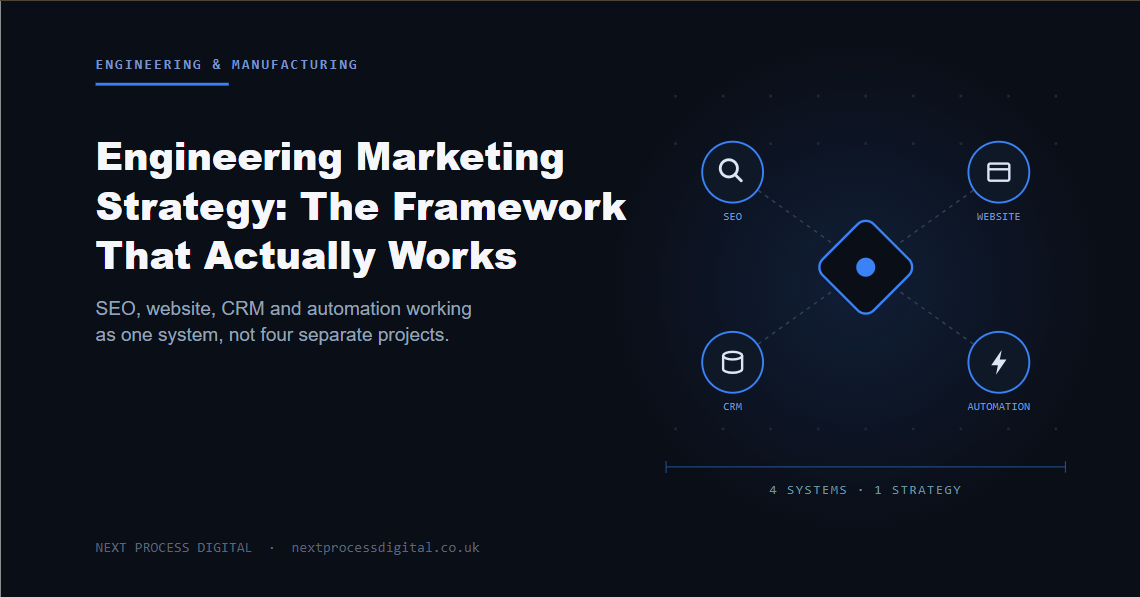
Short answer: an engineering company marketing strategy needs four parts working together, not separately — SEO so you show up when someone searches for what you do, a website that proves capability to a buyer who hasn’t spoken to you yet, a CRM that tracks every quote so nothing gets forgotten, and automated follow-up so speed doesn’t depend on who happens to be free that day. Most engineering marketing advice covers one of these. None of them work well alone.
Last reviewed 26 July 2026 by wren, who builds CRM and automation systems for engineering, trade, and hospitality businesses across Oxfordshire and Northamptonshire.
Why the standard marketing advice doesn’t fit engineering firms
Search “engineering company marketing strategy” and most of what comes back is the same three-step framework: pick a goal, pick a niche, pick a channel. It’s not wrong. It’s just written for companies with a marketing department to execute it. A 15 to 40 person precision engineering or fabrication business in Brackley or Banbury doesn’t have that — the MD is usually doing sales, quoting, and marketing between everything else, which is exactly why the referral pipeline never gets replaced with anything more reliable.
What the generic guides also miss is timing. According to Forrester’s research on B2B buying behaviour, buyers now complete somewhere between 70% and 80% of their evaluation before they ever contact a supplier directly — researching capability, checking case studies, comparing options — long before a phone call or enquiry form is submitted. For an engineering firm, that means the pitch isn’t happening in the sales conversation anymore. It’s happening on the website, three weeks before the buyer ever picks up the phone. If that website doesn’t show up in search and doesn’t answer the buyer’s questions, the firm is out of the running before it knew there was a race.
The four parts, and what each one is actually for
1. SEO — being findable for what you actually do
Not “engineering company Banbury.” Nobody searches that. They search the problem: CNC machining services, precision engineering supplier, subcontract fabrication, paired with the process or material they need. A related read on this is our piece on how to rank on Google for CNC machining services, which walks through exactly this kind of problem-first keyword targeting.
2. Website — proving capability to someone who hasn’t called yet
Data on UK manufacturers backs this up starkly: according to Automation Magazine, only a small fraction of UK manufacturers currently dominate online visibility, while the rest are effectively invisible to the buyer doing that early research. A website that lists services without evidence — tolerances held, industries served, certifications, real project examples — loses to a competitor whose site actually answers the technical questions a buyer has before they’ll pick up the phone. We cover the common failure points in why engineering websites fail.
3. CRM — making sure a quote never just disappears
Referral-driven firms are notorious for running their pipeline from memory, a notebook, or an inbox. That works until volume increases past what one person can track. A proper CRM for engineering companies exists to stop quotes going cold simply because nobody followed up — something we go into detail on in CRM for Engineering Companies.
4. Automation — because speed decides more deals than people think
Harvard Business Review’s widely cited research on lead response times found that contacting a lead within the first few minutes dramatically outperforms waiting even half an hour — and in a business where the MD is also running the workshop floor, that speed can’t depend on whoever happens to check their email first. Automated acknowledgment and follow-up sequences close that gap without adding headcount.
What showing up in search actually looks like for an engineering firm
Ranking well isn’t one keyword — it’s covering the different stages a buyer moves through before they ever pick up the phone:
| Search stage | What they’re typing | What the page needs to prove |
|---|---|---|
| Problem-aware | subcontract fabrication supplier UK, who can CNC machine titanium | You understand the process and material, not just that you “do engineering” |
| Comparing options | CNC machining vs sheet metal fabrication, best precision engineering supplier Oxfordshire | Genuine expertise — tolerances, certifications, industries served — not just a services list |
| Ready to quote | precision engineering quote Banbury, subcontract CNC machining near me | A fast, obvious way to get a quote — no five-click contact form |
Most engineering firms only ever write for the third row — a single “Services” page aimed at someone ready to buy. That leaves the first two stages, where most of the actual search volume sits, completely uncovered.
Common mistakes engineering firms make on their first attempt
We see the same handful of mistakes repeatedly when a firm tries SEO for the first time without outside help:
- Treating the website like a brochure, not evidence. A list of services with no tolerances, certifications, or project examples doesn’t answer the questions a buyer actually has.
- Targeting the company name search, not the problem search. Ranking for “[Company Name] engineering” is close to worthless — almost nobody searches a company they’ve never heard of by name.
- One burst of content, then silence. A flurry of blog posts around a website relaunch, then nothing for a year, rarely holds rankings — consistency compounds, bursts don’t.
- No clear path from “found us” to “got a quote.” Traffic that lands on a page with no obvious next step is traffic that leaves and goes to a competitor instead.
Referral-only vs. a systemised approach
| Area | Referral-Only | Systemised Strategy |
|---|---|---|
| New enquiries | Depends on who remembers you | Found via search, independent of any one contact |
| Quote follow-up | Manual, easily forgotten | Tracked in CRM, automated reminders |
| Response speed | Whoever is free that day | Automated acknowledgement within minutes |
| Pipeline visibility | In someone’s head or inbox | Visible, reportable, transferable |
| Resilience to a quiet quarter | Low — one dry spell empties the pipeline | High — multiple lead sources running at once |
Why this matters more in the Banbury-Brackley-Silverstone corridor specifically
This corridor has an unusually dense concentration of precision engineering, motorsport supply chain, and manufacturing businesses — Brackley and Silverstone alone sit inside what’s often called Motorsport Valley, with Banbury’s Cherwell Business Village and Wildmere Road adding further industrial density nearby. That density cuts both ways: there are more potential clients searching for suppliers in the area, but also more competitors chasing the same referral networks. A firm that shows up in organic search for its specific capability — rather than relying on the same handful of contacts everyone else is also chasing — has a structural advantage that compounds over time, because search rankings don’t reset every quarter the way a referral pipeline can.
For a broader look at how this plays out across the wider engineering and manufacturing sector, see our Engineering & Manufacturing industry page, and for the local business landscape specifically, our Brackley location page.
Book a free strategy call if you want to work through what this would look like for your business specifically.
Frequently Asked Questions
Do we need all four parts, or can we start with just one?
Start with whichever is weakest. If you have no visibility in search, start with SEO. If quotes are going cold, start with CRM. The point isn’t doing everything at once — it’s making sure the parts you do build are designed to connect to the others later, rather than becoming another disconnected tool.
How long before an engineering company marketing strategy like this shows results?
CRM and automation improvements usually show up within weeks — fewer quotes go cold immediately. SEO is slower and compounding, typically three to six months for meaningful ranking movement, which is why starting early matters more than starting perfectly.
Is this only for manufacturers, or does it apply to engineering services and consultancies too?
The same four parts apply whether you’re running CNC machines or providing engineering consultancy — the buyer research behavior, the risk of quotes going cold, and the value of fast follow-up don’t change based on whether you’re selling a physical part or a service.
We already get enough work through referrals. Why change anything?
Referral-only pipelines work well until they don’t — a single client loss, a retiring contact, or a quiet quarter in the referral network can empty the pipeline with no warning. A systemised strategy doesn’t replace referrals, it sits alongside them so one quiet quarter isn’t a crisis.
What’s the fastest way to tell if we’re targeting the wrong keywords?
Check what’s already ranking for the terms you assumed mattered. If the results are all directories, marketplaces, or huge national suppliers rather than businesses your size, that keyword is either too competitive or not what your actual buyers search — a sign to go more specific on process, material, or region.
Get in touch to talk through where your business sits against this framework, and what the fastest fix would be.