A homeowner’s roof starts leaking on a Tuesday morning. They Google “roofer near me,” call the first three results, and book whoever answers first. Two of those roofers were on a job and missed the call. By the time either of them rings back, the job’s already booked — with the one who picked up. CRM for roofers exists to make sure that call never gets lost in the first place, and that the ones who do get through don’t quietly go cold a week later.
Short answer: CRM for roofers means every enquiry — call, form, WhatsApp — lands in one place automatically, with a reminder if a quote goes unanswered instead of relying on memory. Roofing enquiries are unusually weather-driven and time-sensitive, so the gap between “the phone rang” and “someone actually followed up” costs roofers more real jobs than pricing ever does.
Last reviewed 7 August 2026 by wren, who builds SEO, CRM and automation systems for construction and trade businesses across Oxfordshire and Northamptonshire.
If quotes are going out but jobs aren’t coming back, book a free strategy call or call +44 7498 897007.
In This Guide
- Why roofers lose more jobs to missed calls than to price
- Signs a roofing business needs CRM for roofers
- What CRM for roofers actually needs to track
- Why CRM for roofers matters even more during storm season
- What CRM for roofers costs and how long it takes
- A real CRM for roofers example: two roofers, one missed call
- Why CRM for roofers matters around Banbury and Bicester
- Frequently asked questions
Why Roofers Lose More Jobs To Missed Calls Than To Price
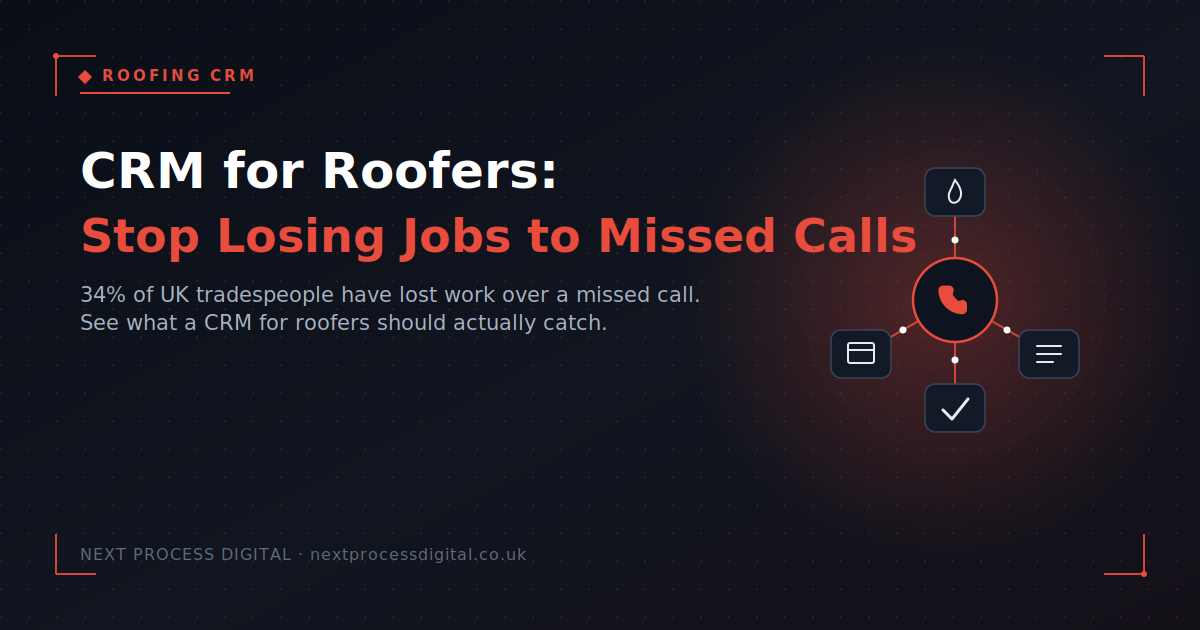
A Fix Radio survey of more than 220 UK tradespeople found that 34% had lost work directly because they didn’t answer their phone, and 60% said they regularly struggle to take calls while on site. For a roofer up a ladder or on a pitched roof, that isn’t a discipline problem — the phone genuinely can’t be answered mid-job.
A separate 2025 study of 142 UK small businesses by Paperclip found that 47% of initial inbound calls go unanswered — nearly half of all new enquiries never reaching anyone at all. Research from MIT and Harvard Business Review’s Lead Response Management Study found that businesses responding to a new enquiry within five minutes are around 100 times more likely to make contact than those who wait thirty minutes.
Roofing sits at the sharper end of this problem. Jobs are urgent by nature — a leak doesn’t wait — and a homeowner comparing quotes after a storm is usually calling three or four roofers back to back. Whoever replies first tends to get the job, not whoever would have done the best work. This is exactly the gap that CRM for roofers is designed to close.
Signs A Roofing Business Needs CRM For Roofers
Most roofers don’t realize how much work is slipping away until they actually start tracking it. A handful of patterns are worth checking for:
- You genuinely can’t say how many calls went unanswered last week, let alone last month
- Enquiries land across several channels — mobile calls, a landline, a contact form, WhatsApp — with no single record of who called and why
- A quote goes out and there’s no reminder to chase it if the homeowner goes quiet
- Storm or high-wind weeks bring a spike of calls that overwhelm whatever informal system exists the rest of the year
- Repeat customers or referrals occasionally get missed because nobody flagged them for a follow-up call
None of this reflects the quality of the roofing work. It reflects whether there’s a system behind the phone catching what a memory and a notebook can’t hold onto once enquiry volume picks up.
What CRM For Roofers Actually Needs To Track
A proper CRM for roofers isn’t a generic sales tool with a roofing logo slapped on it. Done properly, it should track a job through the stages that actually matter for a roofing business:
- Enquiry received — logged automatically from calls, forms, or WhatsApp, including missed calls, not scribbled on the back of an invoice book
- Urgency flagged — a leak or storm-damage enquiry treated differently from a routine re-roof quote, since one needs a same-day response and the other doesn’t
- Site visit booked — with a reminder, so it’s never missed or double-booked during a busy week
- Quote sent — logged with a date, so it’s obvious at a glance how old it is
- Follow-up due — an automatic nudge if a quote hasn’t had a response within a set number of days
- Job won or lost — tracked, so there’s an actual conversion rate instead of a guess
That last point matters more than most roofers assume. Without it, there’s no way to know whether a quiet month is a pricing problem, a follow-up problem, or genuinely quiet demand. Once the numbers are tracked properly, it’s very often follow-up.
Manual Process vs. CRM For Roofers
| Without a CRM | With a CRM for roofers |
|---|---|
| Missed calls disappear with no record | Every call logged, missed or answered |
| Urgent leak jobs treated the same as routine quotes | Urgent enquiries flagged and prioritized automatically |
| Follow-up depends on someone remembering | Automatic reminder if a quote goes unanswered |
| Storm-week call spikes overwhelm the system | Enquiries queue and get tracked automatically, not lost |
| No visibility on how many quotes convert | Clear conversion rate, job by job |
Why CRM For Roofers Matters Even More During Storm Season
Roofing enquiry volume isn’t steady across the year — it spikes hard after high winds, storms, or heavy rain, exactly when a firm’s informal system is least able to cope. A run of bad weather can generate a week’s worth of calls in a couple of days, all from homeowners in some degree of urgency, several of them calling more than one roofer at once.
Without a system to catch that spike, the firm’s usual process — someone remembers to call back when they get a minute — collapses under the volume. A CRM for roofers handles that surge the same way it handles a quiet Tuesday: every call logged the moment it comes in, urgent ones flagged, and nothing depending on anyone’s memory during the busiest week of the month.
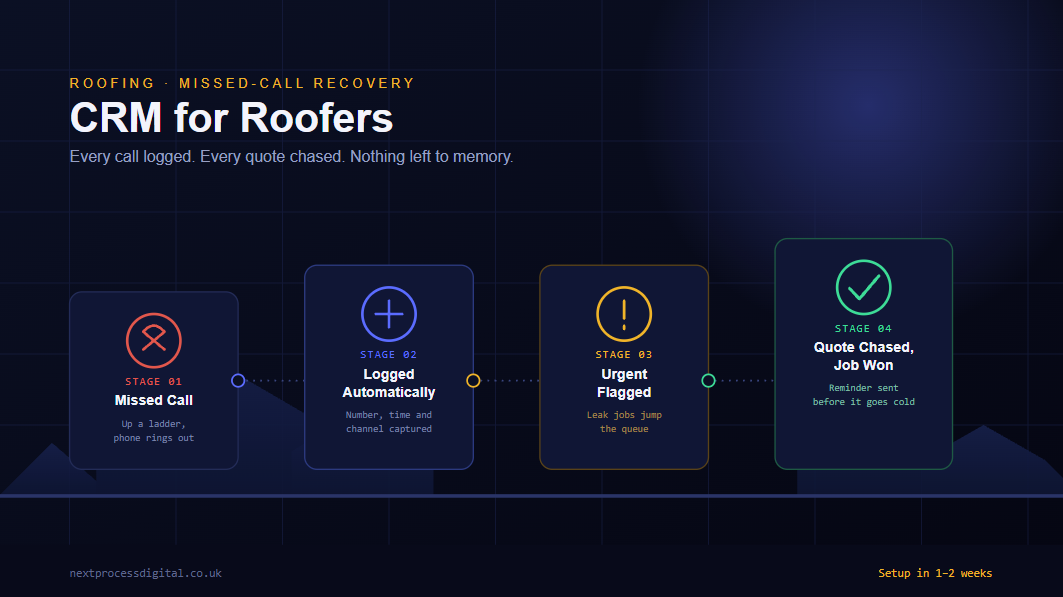
A CRM for roofers dashboard keeping every enquiry, urgency flag, and follow-up reminder in one place.
What CRM For Roofers Costs And How Long It Takes
Most roofing firms should budget for this as a focused, practical setup rather than an expensive platform rollout — logging enquiries automatically, flagging urgency, and reminding someone to chase a quote don’t require complex software. Cost depends mainly on how many channels enquiries currently come through and how messy the existing process is to untangle.
A working CRM for a roofing firm typically takes one to two weeks to set up and start using properly. The first real signal — fewer quotes going quiet without a follow-up — tends to show up within the first month of consistent use, and the storm-week benefit becomes obvious the first time a genuine spike hits.
A Real CRM For Roofers Example: Two Roofers, One Missed Call
Picture two roofers covering the same patch, both genuinely good at the work. A homeowner calls both after spotting a leak. One roofer is up a ladder and misses the call — no record, no callback, nothing. The other misses the call too, but it’s logged automatically and flagged as urgent, and a text goes out within minutes acknowledging the job and asking a few quick questions.
The homeowner books a site visit with the second roofer that afternoon. The first roofer never even finds out the enquiry existed. Neither roofer did anything wrong on the job itself — the entire outcome was decided by which one had a system behind the phone.
Why CRM For Roofers Matters Around Banbury And Bicester
Roofers working across Banbury, Bicester, and the surrounding towns are competing for the same pool of homeowners, most of whom call more than one roofer before deciding. In that environment, a firm that answers or follows up within the hour has a real edge over one that gets back a day later, even when the pricing is nearly identical.
We work with construction and trade businesses across this area to set up a CRM built around how roofing actually works — urgent leak calls, storm-driven spikes, and quotes that need chasing before a homeowner books someone else. For the visibility side that feeds this CRM, see our companion piece on CRM for Builders, and for what happens when the follow-up system isn’t there at all, see Why Roofers Lose Leads.
Book a free strategy call: get in touch online or call +44 7498 897007 to see exactly where your enquiries are currently falling through.
Frequently Asked Questions
Is CRM For Roofers Worth It For A Small Or One-Person Operation?
Often more so than for a larger firm. A sole trader up a ladder has nobody else to catch a missed call, which means the cost of a lost enquiry falls entirely on one person’s memory.
Will This Change How We Actually Quote Or Price Jobs?
No. It sits around the existing quoting process and makes sure nothing gets forgotten once a call comes in or a quote goes out — it doesn’t touch how a job is priced or written up.
How Does CRM For Roofers Handle A Sudden Spike After A Storm?
Every call gets logged automatically the moment it comes in, regardless of volume, and urgent jobs get flagged so they don’t get buried under routine enquiries during the busiest week of the month.
What’s The Difference Between CRM For Roofers And A Generic Off-The-Shelf CRM?
Generic CRMs are usually built for office-based sales teams working phone-based deals during business hours. A CRM for roofers is set up around missed calls, urgency, and enquiries that arrive at all hours, because that’s how roofing actually works.
Do We Need To Replace How We Currently Take Calls?
No. It works alongside your existing phone and booking process — the difference is that every call gets logged and followed up automatically, rather than depending on someone remembering during a busy week.
What Should We Set Up First?
Automatic call and enquiry logging, plus a follow-up reminder on quotes, are usually the fastest wins — they’re the two places most roofing firms are currently losing jobs without realizing it.
If calls are coming in but jobs aren’t converting the way they should, get in touch or call +44 7498 897007 and we’ll show you exactly what’s realistic to fix first.