The average vacation rental website converts at just 0.32% — roughly one booking for every 300 visitors. Top-performing properties reach over 2%, more than six times better, from the same traffic. The difference isn’t luck or location. Holiday let website design either gives a browsing guest enough confidence and clarity to book directly, or it quietly sends them back to Airbnb to finish the job instead.
Short answer: holiday let website design that converts means professional, well-sequenced photography (25-35 images, not a handful of phone snaps), a simple booking flow with live availability and real pricing, genuine local content beyond the property itself, and a site that works properly on mobile. Most holiday let sites lose bookings not because the property isn’t appealing, but because the site fails to build the confidence a guest needs before typing in their card details.
Last reviewed 7 August 2026 by the Wren, who design websites for hospitality and holiday let businesses across Oxfordshire and Warwickshire.
This isn’t just a hunch about what makes a guest book. Data compiled by StayFi, citing Direct Booking Tools research, puts the average vacation rental website conversion rate at 0.32%, against 1.2% typical and up to 2.1% for top-performing managers. Separate research on vacation rental photography found properties with professional photography convert at two to three times the rate of equivalent properties using amateur photos, and rank higher in search results as a direct result of that improved conversion. The gap between an average site and a genuinely well-designed one isn’t small — it’s the difference between a website that pays for itself and one that quietly underperforms every single month.
Why Most Holiday Let Websites Underperform
Most owners build a website once, early on, and rarely revisit it. A handful of phone photos, a short description, a “contact us for availability” box — adequate at launch, but never built to actually compete once OTA algorithms and other local properties are the real competition for a guest’s attention. This is usually the clearest sign that holiday let website design was never revisited past the initial launch.
The problem is rarely the property itself. It’s that the site was never built around how a guest actually decides — comparing photos first, checking real pricing and availability, then looking for enough trust signals to book directly rather than defaulting to a platform they already know.
Signs Your Website Is Losing Bookings
- The photo gallery has fewer than fifteen images, or photos that look clearly amateur compared to the OTA listing
- There’s no live availability calendar, requiring an email or call just to check open dates
- Pricing isn’t visible without contacting the owner directly
- The site isn’t genuinely mobile-friendly, despite most guests browsing and booking on a phone
- There’s no content beyond the property itself — nothing about the local area, nearby attractions, or what makes the location worth visiting
None of this reflects the quality of the stay. It reflects whether the holiday let website design was ever built to actually convert a browsing guest, rather than simply exist as a digital business card alongside the OTA listing doing the real work.
Picture two similar Cotswolds cottages. One has twelve photos taken on a phone, no visible pricing, and a “get in touch” form. The other has thirty professionally shot, well-sequenced photos, a live calendar showing real availability and price, and a page about walks and pubs nearby. Both get similar traffic from search and social. The second consistently converts several times more of that traffic into actual bookings — not because the cottage is nicer, but because the guest never had to leave the site to get the confidence they needed.
Want to see exactly where your website is losing bookings right now? Get in touch or call 07498 897007 and we’ll show you.
What Good Holiday Let Website Design Actually Looks Like
- 25-35 well-sequenced photos — a strong cover shot, then living spaces, bedrooms, outdoor areas, and lifestyle images, not just an empty room-by-room inventory
- Live availability and real pricing — a calendar and instant quote, not a form that requires waiting for a reply
- A simple, trustworthy booking flow — capturing payment and details without the guest ever needing to leave the site or wonder if it’s secure
- Genuine local content — walks, pubs, attractions nearby, capturing guests still deciding on a destination, not just a specific property
- Mobile-first design — tested on an actual phone, since most guests are researching and often booking from one
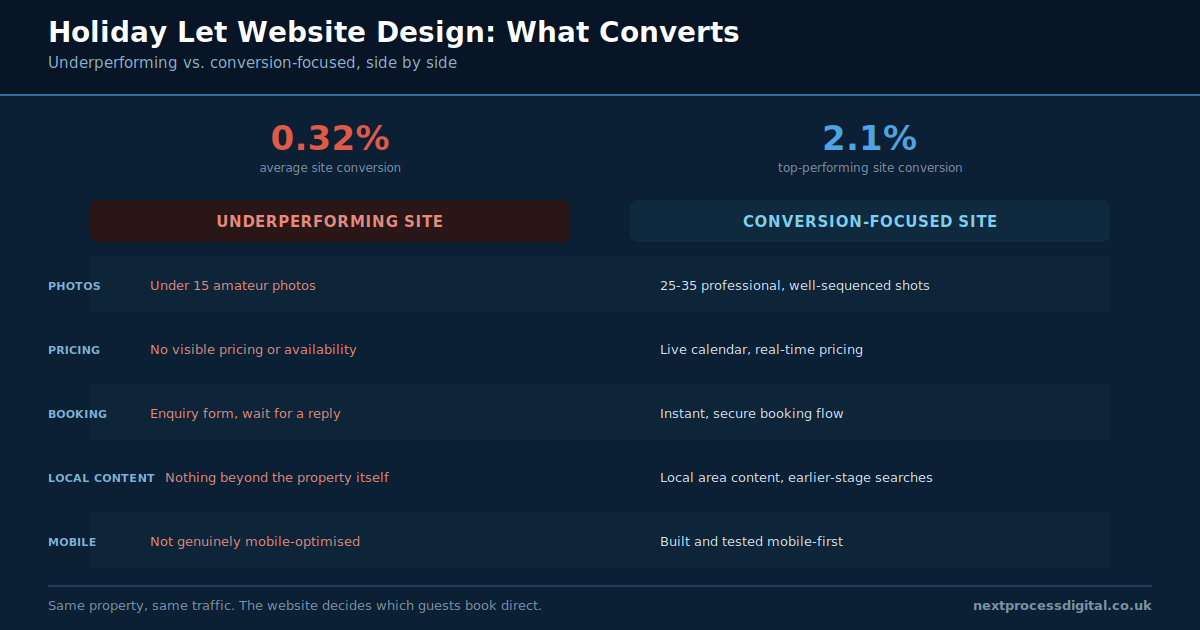
Quick Reference: Underperforming vs. Conversion-Focused Holiday Let Website Design
| Underperforming site | Conversion-focused site |
|---|---|
| Under 15 amateur photos | 25-35 professionally shot, well-sequenced images |
| No visible pricing or availability | Live calendar with real-time pricing |
| Enquiry form requiring a wait for a reply | Instant, secure booking flow |
| No content beyond the property | Local area content capturing earlier-stage searches |
| Not genuinely mobile-optimized | Built and tested mobile-first |
How Much Does Holiday Let Website Design Actually Cost?
Costs vary more than most owners expect, mainly because the biggest input isn’t the build itself — it’s the photography and copy that feed it. An owner who already has a strong, recent photo set and a clear sense of what’s worth saying about the local area is starting most of the way there. An owner starting from nothing is really commissioning three things at once: photography, local area writing, and the site and booking flow itself.
As a rough guide, a professional half-day shoot for a typical three-to-four bedroom cottage runs to a few hundred pounds and covers most of what a 25-35 image gallery needs. Local area content — walks, pubs, what’s nearby — is usually the cheapest line item but the one owners skip most often, which is exactly the content that captures guests still comparing destinations rather than specific properties. The booking flow and live calendar integration is where cost varies the most, since it depends on which channel manager or booking engine the property already uses and whether it needs to sync two-way with Airbnb and Booking.com to avoid double-bookings.
Most single-property holiday let website design projects, covering photography direction, copywriting, and a built and tested site, land somewhere between a smaller weekend-project budget and a proper small-business website spend, with the booking integration usually the deciding factor. Owners managing several properties tend to see the cost per property fall, since the photography brief, local content structure, and booking integration only need solving once.
Where Holiday Let Website Design Meets Everything Else
Good holiday let website design still needs guests to actually find it and, once they book, a system to keep the relationship going. We’ve covered the OTA commission side of this in holiday let marketing, the same principle applies to independent hotels in hotel SEO, and once bookings and enquiries start coming in more consistently, they need tracking — the gap covered in our piece on CRM for hotels and holiday lets. Design, visibility, and follow-up all have to work together; a beautiful site nobody finds, or a well-found site that guests bounce off before booking, both leave the same revenue on the table.
What This Looks Like For Holiday Lets Across The Region
Holiday let owners across Banbury, Chipping Norton, Woodstock, and Stratford-upon-Avon are typically competing with dozens of similar Cotswolds and countryside properties, most relying entirely on OTA listings with no direct booking website of their own. In that environment, genuinely well-designed holiday let website design is one of the clearest ways to stand out and keep more of what a stay actually earns. We work with hospitality businesses across this region to build exactly that kind of site, paired with the visibility and follow-up work that gets it actually converting.
Frequently Asked Questions
Do we need professional photography, or will good phone photos do?
Professional photography makes a measurable difference — properties with it convert at two to three times the rate of amateur photos. It’s typically one of the highest-return investments available to a holiday let owner.
How many photos should our website actually have?
Around 25-35, well-sequenced from a strong cover shot through living spaces, bedrooms, and outdoor areas. Thinner galleries consistently underperform on both clicks and booking conversion.
Is a live booking calendar really necessary, or is an enquiry form enough?
Live availability and instant booking convert far better. A guest comparing several properties rarely waits around for a reply before booking somewhere else that lets them book immediately.
How long does it take to build proper holiday let website design?
A focused build covering photography, booking flow, and local content typically takes a few weeks, depending on how much of the photography and copy needs creating from scratch.
Is holiday let website design worth it if we already do well on Airbnb?
Yes — a well-designed direct booking site doesn’t replace Airbnb, it adds a commission-free channel alongside it, particularly valuable for repeat guests who’d happily book direct if given an easy, trustworthy way to.
If your website isn’t converting the traffic it already gets, the fastest way to find out why is a proper look at where guests are currently dropping off. Get in touch or call 07498 897007 and we’ll show you exactly what’s realistic to fix first.