
A procurement manager is shortlisting suppliers for a machining contract. She finds three companies online, and by the time she picks up the phone to any of them, she’s already ruled two out based on their websites alone — one looked outdated, one didn’t show enough about tolerances or certifications to seem credible. Manufacturing website design decides which shortlist a firm makes before a salesperson ever gets a chance to speak to the buyer.
Short answer: manufacturing website design needs to answer a buyer’s technical and credibility questions before they ever contact sales — clear capability pages, visible certifications, real project examples with specifics, and fast, mobile-friendly performance. B2B buyers typically complete the majority of their purchasing research independently, so a manufacturing site that reads like a static brochure loses shortlist spots to competitors whose sites actually do the selling.
Last reviewed 7 August 2026 by wren, who builds SEO, CRM and websites for engineering and manufacturing businesses across Oxfordshire and Northamptonshire.
If your site isn’t making the shortlist before the phone even rings, book a free strategy call or call +44 7498 897007.
In This Guide
- Why manufacturing website design decides the shortlist before sales gets involved
- Signs a manufacturing website design is losing shortlist spots
- What manufacturing website design should actually get right
- Generic template vs. purpose-built manufacturing website design
- What manufacturing website design costs and how long it takes
- A real example: two suppliers, one shortlist
- Why manufacturing website design matters around Brackley and Silverstone
- Frequently asked questions
Why Manufacturing Website Design Decides The Shortlist Before Sales Gets Involved
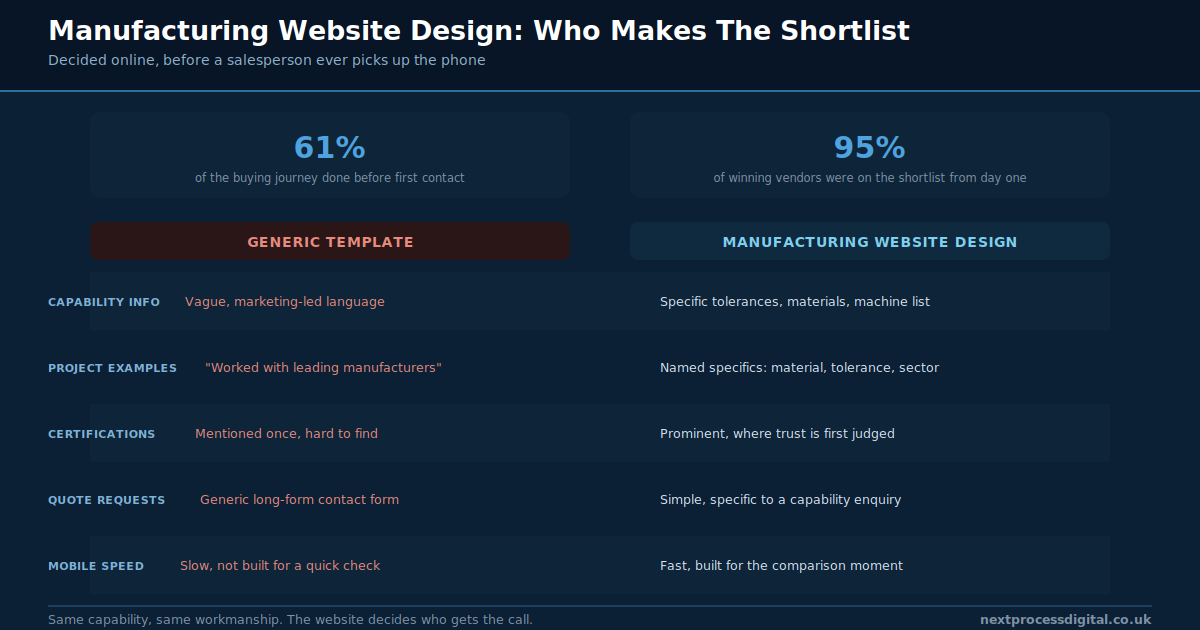
Research compiled by The SEO Works on B2B buyer behaviour found that by the time a buyer makes first contact with a salesperson, they’ve typically already completed 61% of their purchasing journey — the majority of the decision has already happened by the time the phone rings. The same research found that 95% of the time, the vendor that eventually wins the contract was already on the buyer’s shortlist from day one.
For a manufacturing or engineering supplier, that means the website isn’t a brochure sitting alongside the sales process — it effectively is the first stage of the sales process. A buyer comparing three or four potential suppliers online is deciding who gets a phone call largely based on what their site shows about capability, certifications, and past work, long before any conversation happens.
Most manufacturing website design hasn’t kept pace with that reality. Many sites still read as a static “About us and our machines” page from a decade ago, which quietly rules a firm out of shortlists it never even knew it was being considered for.
Signs Your Manufacturing Website Design Is Losing Shortlist Spots
Most manufacturers assume their site is “fine” because nobody’s complained about it. A handful of patterns are worth checking directly:
- Capability information — tolerances, materials, certifications — is thin, outdated, or buried several clicks deep
- Past project examples are vague (“we’ve worked with leading UK manufacturers”) rather than specific about what was actually made
- The site takes several seconds to load on mobile, where a procurement manager doing a quick shortlist check is often browsing
- There’s no clear way to request a quote without a lengthy generic contact form
- Certifications like ISO 9001 or AS9100 are mentioned once, if at all, rather than shown prominently where a buyer is forming a first impression
None of this reflects the quality of the manufacturing work. It reflects whether the manufacturing website design was ever built to actually convince a buyer who will never speak to a human before deciding who makes the shortlist.
What Manufacturing Website Design Should Actually Get Right
1. Capability pages that answer real technical questions
Tolerances held, materials worked with, machine list, certifications — the specific information a buyer needs to qualify a supplier, presented clearly rather than implied through vague marketing language.
2. Specific project examples, not generic claims
“5-axis CNC machining to ±0.01mm for an aerospace bracket” tells a buyer far more than “precision engineering for leading manufacturers.” Specificity is what actually builds credibility with a technical audience.
3. Certifications and accreditations shown prominently
ISO 9001, AS9100, or sector-specific accreditations should sit where a buyer forms their first impression, not buried on a policies page nobody clicks through to.
4. Fast, mobile-first performance
Procurement research increasingly happens on a phone or tablet during a quick comparison session. A slow-loading site loses that moment before a buyer even reaches the capability information underneath.
Generic Template vs. Purpose-Built Manufacturing Website Design
| Area | Generic Template | Built For Manufacturing Buyers |
|---|---|---|
| Capability info | Vague, marketing-led language | Specific tolerances, materials, machine list |
| Project examples | “Worked with leading manufacturers” | Named specifics: material, tolerance, sector |
| Certifications | Mentioned once, hard to find | Prominent, where trust is first judged |
| Quote requests | Generic long-form contact form | Simple, specific to a capability enquiry |
| Mobile speed | Slow, not built for a quick shortlist check | Fast, built for the comparison moment |
What Manufacturing Website Design Costs And How Long It Takes
Manufacturing website design costs vary mainly by scope. Most manufacturing and engineering firms should budget for this as a proper rebuild rather than a cosmetic refresh, since the real value sits in restructuring capability information and adding specific project detail, not just changing the visual template. Cost depends mainly on how much existing technical content, photography, and case study detail already exists versus needing to be gathered from scratch.
A properly built manufacturing website typically takes six to ten weeks from first draft to launch, including gathering and structuring the technical capability content that actually does the convincing. The shortlist benefit compounds from the moment the new site goes live — every buyer who now finds clear, specific capability information is a buyer who no longer rules the firm out before making contact.
A Real Example: Two Suppliers, One Shortlist
Picture two precision engineering firms with genuinely comparable capability, both bidding informally for the same type of contract work. One’s manufacturing website design has a single “Capabilities” page with a paragraph of general text and no named project examples. The other’s site breaks capability down by material and tolerance, with three or four specific past projects described in enough detail that a buyer can see exactly what the firm has actually done.
A procurement manager researching both companies rules the first one out — not because the work is worse, but because there’s not enough information to qualify them without a phone call, and she’s trying to get through a shortlist without making six calls. The second firm gets the call. Neither firm did anything wrong on the shop floor. The website decided who got considered.
Why Manufacturing Website Design Matters Around Brackley And Silverstone
The Brackley and Silverstone corridor has an unusually dense cluster of precision engineering, CNC machining, and motorsport supply firms, many bidding into the same tier-one and tier-two supply chains. In a market where buyers are comparing several genuinely capable local firms, manufacturing website design that clearly demonstrates tolerances, certifications, and specific past work is often the deciding factor in who gets shortlisted at all.
We work with engineering and manufacturing businesses across Brackley, Silverstone, and Daventry to build websites structured around what a technical buyer actually needs to see. For the search visibility side that gets a site found in the first place, see our companion piece on SEO for Engineering Companies, and for what happens once an enquiry actually lands, see CRM for Engineering Companies.
Book a free strategy call: get in touch online or call +44 7498 897007 to see exactly what your current site is showing — or failing to show — a buyer doing their shortlist research.
Frequently Asked Questions
Is manufacturing website design worth it for a smaller firm competing on relationships, not just price?
Often more so — a smaller firm has fewer chances to make a first impression, and a clear, credible website is one of the few ways to compete for shortlist spots against larger, better-known suppliers before a relationship ever gets the chance to form.
Will this change how we present ourselves in person or in meetings?
No. It’s about making sure a buyer who’s never met anyone from the firm can still qualify it as credible online — the website does the work that used to depend entirely on a first meeting or a trade show conversation.
What technical detail is actually worth including?
Tolerances held, materials and processes offered, relevant certifications, and specific past project examples — the details a buyer needs to rule a supplier in, not general claims about quality or experience.
How is manufacturing website design different from a generic small business website template?
Generic templates are built for consumer trust signals — reviews, testimonials, a friendly tone. A manufacturing buyer is looking for technical qualification information first, and a generic template usually doesn’t have anywhere obvious to put it.
Do we need new photography, or can we reuse what we have?
It depends on what already exists — clear, well-lit photography of real work and equipment is worth reusing if it exists, and worth prioritizing early if it doesn’t, since generic stock imagery undermines exactly the credibility a manufacturing site needs to build.
What should we fix first if we can’t do a full rebuild yet?
Usually the capability pages — replacing vague marketing language with specific tolerances, materials, and named project examples tends to be the fastest, highest-impact fix on an existing site.
If your website isn’t earning your firm a spot on shortlists it should be winning, get in touch or call +44 7498 897007 and we’ll show you exactly what’s realistic to fix first.