
Engineering lead generation often breaks down after the enquiry has already arrived, not before it. A firm’s website gets a new enquiry through a contact form on a Tuesday afternoon. Nobody checks that inbox until Thursday morning, by which point the buyer has already had a call back from two competitors and mentally moved on. The work was there. Nobody lost it on price or capability — it was lost to silence.
Short answer: engineering lead generation isn’t one channel — it’s SEO and a website that gets the right technical buyers finding the firm, paired with a fast, tracked response process once they enquiry. Most engineering companies lose winnable work not because of price or capability, but because an enquiry sits unanswered for a day or two while a competitor replies within the hour. Fixing visibility without fixing response speed only gets you more enquiries that go cold the same way.
Last reviewed 8 August 2026 by wren, who builds SEO, websites and CRM systems for engineering and manufacturing businesses across Oxfordshire and Northamptonshire.
If enquiries are coming in but not turning into quoted work, book a free strategy call or call 07498 897007 — we’ll walk through exactly where your engineering lead generation is currently losing enquiries.
In This Guide
- Why engineering lead generation fails before a quote is ever sent
- Signs your engineering lead generation is losing winnable work
- What actually works for engineering lead generation
- A real example: what losing an enquiry to slow response actually costs
- What this costs and how long it takes
- What realistic results look like
- Engineering lead generation around Brackley and Silvers-tone
- Frequently asked questions
Why Engineering Lead Generation Fails Before A Quote Is Ever Sent
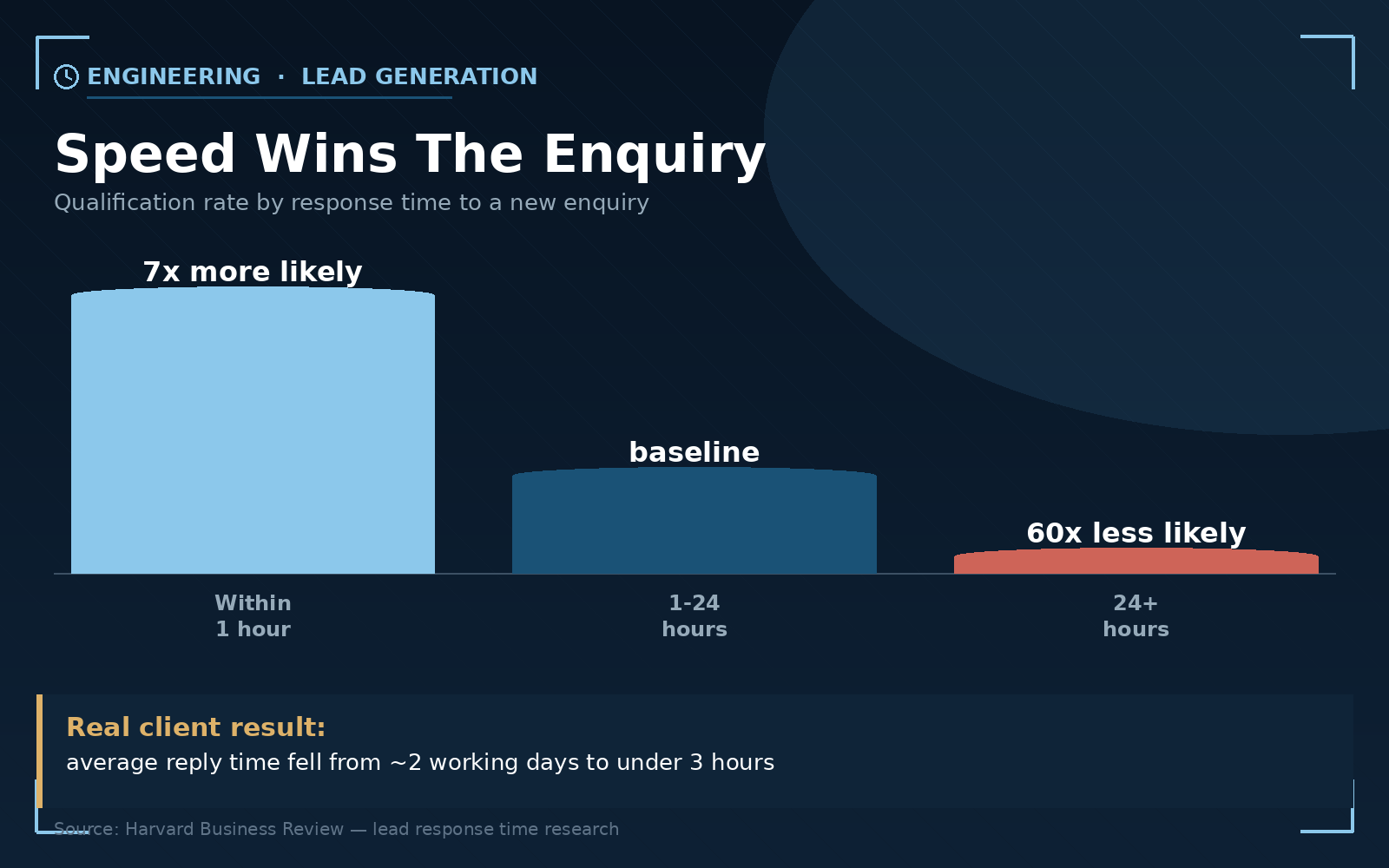
Research published in Harvard Business Review found that firms contacting a new enquiry within the first hour were nearly seven times more likely to qualify that lead than firms that waited even an hour longer, and firms that took 24 hours or more were around 60 times less likely to qualify the same lead. For an engineering buyer comparing two or three suppliers with genuinely similar capability, response speed alone is often deciding who gets the conversation at all — which is exactly why response time sits at the center of any engineering lead generation process that actually converts.
Visibility has its own separate problem. Analysis of B2B website conversion by First Page Sage puts typical visitor-to-lead conversion for industrial and manufacturing websites among the lowest of any B2B sector, reflecting how long and technical the evaluation process usually is before a buyer ever fills in a form. And separate research citing 6sense data found that 95% of deals are won by a vendor who was already on the buyer’s shortlist — meaning a firm that isn’t visible early in a buyer’s research is very rarely winning the work later, no matter how good the eventual quote is.
Put together, this is why engineering lead generation has to solve two different problems at once: getting found by the right technical buyer in the first place, and then not letting that enquiry go cold once it lands. We cover the visibility side in more depth in Why Engineering Websites Fail, since a site that isn’t built to answer a technical buyer’s question rarely generates the enquiries this article is about handling.
Signs Your Engineering Lead Generation Is Losing Winnable Work
- Enquiries sit in a shared inbox or come through a generic contact form with no routing or urgency
- Nobody tracks how long it actually takes to reply to a new enquiry
- The website ranks for the company name but not for the services or capabilities a buyer would actually search
- Quotes get sent but nobody follows up if the buyer goes quiet
- There’s no record of which enquiries turned into work and which didn’t, so the same mistakes repeat
None of this reflects the quality of the engineering. It reflects whether the front end of engineering lead generation — getting found, and then responding fast once found — is actually built to convert, rather than left to whoever happens to check email that day.
What Actually Works For Engineering Lead Generation
1. Build Engineering Lead Generation Around What Buyers Actually Search
A buyer researching suppliers searches for the capability — “precision CNC machining Oxfordshire,” “5-axis milling supplier” — not a company name they’ve never heard of. If the site isn’t built around those searches, it’s invisible to the buyers doing exactly the research that would lead to an enquiry, and invisible research means engineering lead generation never gets the chance to start.
2. Make The Enquiry Form Fast And Specific
A short form asking for the details engineering buyers actually have ready — material, quantity, drawing upload, target timeline — converts better than a generic “get in touch” form, and gives whoever picks it up enough to respond properly on the first reply, which is often where engineering lead generation quietly wins or loses the enquiry.
3. Respond Inside The First Hour, Every Time
Given how sharply qualification rates drop after just an hour, this is the single highest-leverage fix available to most in-house engineering lead generation efforts, and usually the cheapest to implement — it’s a process change, not a technology purchase.
4. Track Every Enquiry To A Result
Without a record of what came in and what it turned into, there’s no way to see where engineering lead generation is actually losing leads — slow response, no follow-up, or genuine loss on price — and no way to fix the right problem.
Generic Handling vs. Engineering Lead Generation Built To Convert
| Area | Generic Handling | Built To Convert |
|---|---|---|
| Website visibility | Ranks for company name only | Ranks for capability and service searches |
| Enquiry form | Generic “get in touch” contact form | Short form capturing spec, quantity, timeline |
| Response time | Whenever someone checks the inbox | Inside the first hour, tracked |
| Follow-up | Quote sent, then silence if no reply | Scheduled follow-up if the buyer goes quiet |
| Reporting | No record of what converted or why | Every enquiry tracked to a result |
A Real Example: What Losing An Enquiry To Slow Response Actually Costs
Picture a subcontract CNC firm handling ten to fifteen new website enquiries a month, most arriving through a standard contact form checked whenever whoever’s nearest a screen gets to it. On one precision engineering client we reviewed before on-boarding, the average time between an enquiry landing and someone actually replying was just under two working days — not because anyone was ignoring it, but because nobody owned it and nobody was measuring it. It’s a gap that shows up in nearly every engineering lead generation audit we run.
Once every enquiry was routed automatically to a named person with a same-day reply target, and a reminder fired if nothing had gone out within a few hours, that average dropped to under three hours. The quote-to-enquiry ratio improved within the first month, without a single change to pricing, capability, or the sales pitch itself. The buyers hadn’t changed. The work hadn’t changed. The only thing that changed was how quickly somebody picked up the phone.
This is the pattern behind most “we don’t get enough work from the website” complaints we hear from engineering firms. The enquiries were often already arriving. They just weren’t being answered fast enough to still be live by the time someone got round to them.
The turnaround, in one number: once every enquiry had a named owner and a same-day reply target, this client’s average response time fell from just under two working days to under three hours — roughly a 16x improvement that came entirely from process, without spending a penny more on marketing.
What This Costs And How Long It Takes
Most engineering firms tackle this as two separate pieces of spend rather than one project. The first is a largely fixed, one-off fix to the response process itself — routing enquiries to a named owner, replacing a generic contact form, and setting up automatic follow-up reminders. The second is an ongoing SEO and content programme to grow the number of enquiries worth responding to in the first place — the other half of any complete engineering lead generation strategy.
The first strand is usually the cheaper and faster of the two, since it’s mostly a process and light automation fix rather than a content-heavy build. Getting enquiry routing, a proper form, and follow-up reminders live typically takes one to three weeks, and the effect is often visible within days — enquiries stop sitting unanswered because there’s now a named owner and a reminder if nobody’s replied.
The visibility side takes longer, in line with what we cover in SEO for Engineering Companies: building out capability pages typically takes four to eight weeks, and ranking consistently against established local competitors usually takes three to six months of consistent, specific content. Most firms are better off fixing response speed first, since it pays back on the enquiries already arriving while the visibility work builds in the background.
What Realistic Results Look Like
The earliest and most reliable signal isn’t more enquiries — it’s fewer enquiries going quiet. Average response time is the number to watch first, since it’s entirely within a firm’s own control and usually improves within the first week of routing and reminders being switched on.
A meaningful shift in quote-to-win rate takes longer to show clearly, because it depends on enough enquiries running through the fixed process to see a genuine pattern rather than one good month. Most firms see that number move over two to three months. Growth in the raw number of enquiries follows a slower curve again, tied to how quickly new SEO and content work starts ranking — typically three to six months in a corridor with established local competition, and longer against nationally established competitors.
Firms that treat this as an ongoing programme rather than a one-off fix tend to keep compounding both numbers, since every new capability page and every enquiry logged to an outcome makes the next quarter’s data more useful than the last — which is really what a mature engineering lead generation programme looks like in practice.
Engineering Lead Generation Around Brackley And Silvers-tone
The Brackley, Silvers-tone and Daventry corridor has a dense cluster of precision engineering, CNC machining and motorsport supply firms — from the specialist manufacturers based on Silvers-tone Park’s technology cluster to the subcontract engineering businesses on Brackley’s Buckingham Road and Top Station Road industrial estates — many chasing the same buyers and the same tier-one and tier-two contracts. In a market with this many genuinely capable local competitors, the firm that gets found first and replies fastest is frequently the one that gets the conversation — regardless of which firm could ultimately do the better job. Local engineering lead generation in this corridor comes down to exactly that combination of visibility and speed.
We work with engineering and manufacturing businesses across this corridor on both sides of the problem. For the visibility side, see our piece on SEO for Engineering Companies. For what should happen to an enquiry once it lands, see CRM for Engineering Companies. And for what the site itself needs to show a technical buyer, see Engineering Website Design.
Book a free strategy call: get in touch online or call 07498 897007 to see exactly where enquiries are currently being lost.
Frequently Asked Questions
Is SEO or response speed the bigger priority for engineering lead generation?
Response speed usually pays back faster since it’s a process fix, not a technology or content investment. But SEO determines how many enquiries there are to respond to in the first place, so most firms need to work on both rather than picking one.
How fast is “fast enough” when responding to a new enquiry?
Within the first hour where possible. Qualification rates drop sharply the longer a buyer waits, and a same-day reply that feels prompt to the sender can still be too slow compared to a competitor who replied in minutes.
Do we need a CRM to fix this, or can email work?
Email can work for very low volumes if someone disciplined checks it constantly, but most firms lose leads exactly because that discipline slips. A CRM with automatic routing and reminders removes the dependency on any one person remembering to follow up — and gives an engineering lead generation programme a proper record to improve against.
What should an engineering enquiry form actually ask for?
Enough to let whoever responds give a useful first reply — material, approximate quantity, a drawing or spec upload if relevant, and a rough timeline. Too short and the first reply is just “tell us more”; too long and buyers abandon the form.
How is engineering lead generation different from generic B2B lead generation?
Engineering buyers evaluate on technical capability and specificity, not general trust signals, and the sales cycle is usually longer and more considered. Engineering lead generation has to answer technical qualification questions early rather than relying on generic marketing claims to carry the conversation.
How do we know if we’re losing leads to slow response versus genuinely losing on price?
Only by tracking response time and outcome against every enquiry. Without that record, “we lost it on price” and “we lost it because nobody replied for three days” look identical from the outside — and get fixed completely differently.
What does it typically cost to fix engineering lead generation, and how quickly does it pay back?
Fixing the response process — routing, a proper enquiry form, follow-up reminders — is usually the smaller and faster investment, often paying back within the first month simply from enquiries that would otherwise have gone cold. Growing the number of enquiries through SEO and content is a longer-term investment, typically showing measurable movement over three to six months.
If enquiries are coming in but not turning into quoted work, the fastest way to find out why is a proper look at how they’re currently being handled. Get in touch or call 07498 897007 and we’ll show you exactly what’s realistic to fix first.