
A guest finds a boutique hotel on Google, opens the website on their phone, and decides within seconds whether to book direct or just go back to Booking.com where the room looked easier to reserve. Most of the time, that guest goes back to the OTA — not because the hotel is worse, but because the website made booking direct feel harder than it should. Hotel website design is what decides which way that moment goes.
Short answer: hotel website design exists to make booking direct genuinely easier and more appealing than booking through an OTA — fast pages, real photography, a booking engine that works in two or three taps, and rates that are at least as good as what’s on Booking.com. Independent hotels currently lose the majority of their bookings to OTAs paying 15–25%+ commission, and a large share of that is a website problem, not a demand problem.
Last reviewed 7 August 2026 by wren, who builds SEO, CRM and websites for hospitality businesses across Oxfordshire and Warwickshire.
If your site is quietly sending guests back to the OTAs, that’s worth fixing before the next commission invoice lands — book a free strategy call or call +44 7498 897007.
In This Guide
- Why hotel website design matters more than it used to
- Signs your hotel website design is losing direct bookings
- What hotel website design should actually get right
- Hotel website design: generic template vs. built for direct bookings
- What hotel website design costs and how long it takes
- A real example: hotel website design in action
- Why hotel website design matters around Chipping Norton and Woodstock
- Frequently asked questions
Why Hotel Website Design Matters More Than It Used To
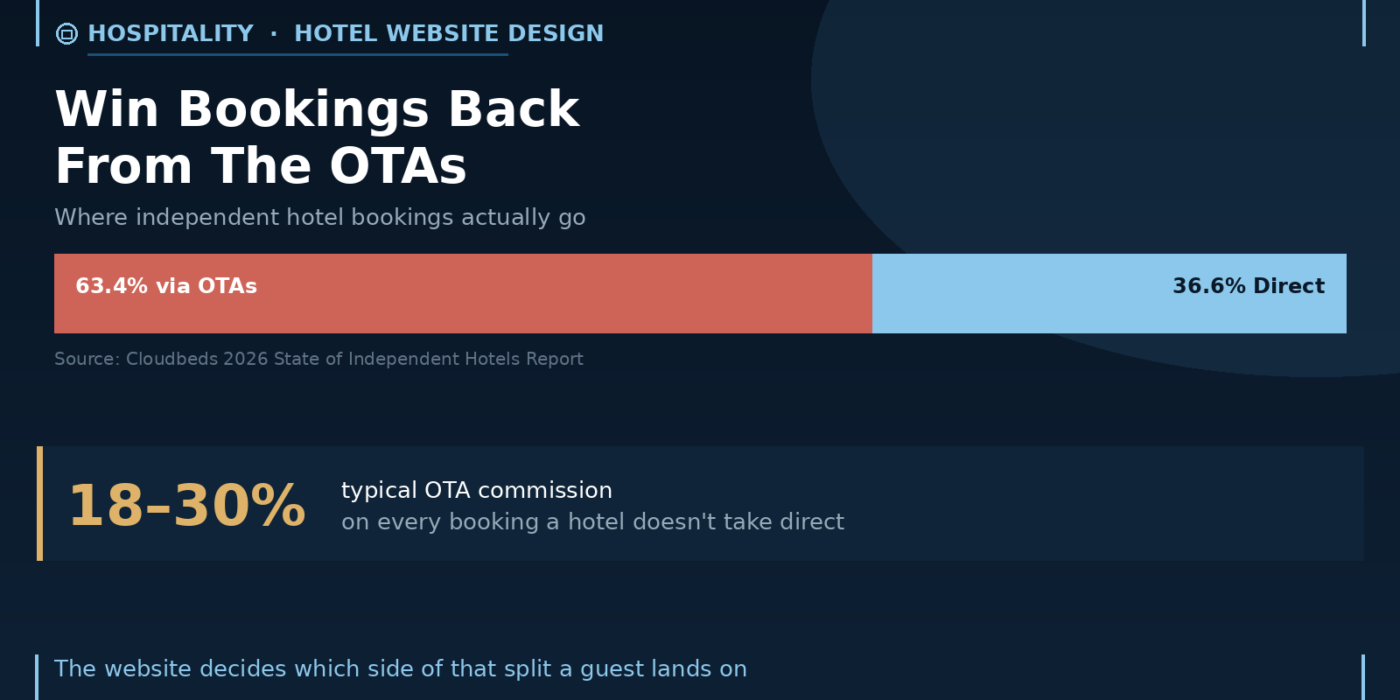
The Cloudbeds 2026 State of Independent Hotels Report, compiled from around 90 million bookings across more than 180 countries, found that OTAs accounted for 63.4% of independent hotel bookings in 2025 — rising to nearly 80% in some markets. The same report found OTA bookings cancel at more than double the rate of direct bookings, meaning even the volume OTAs deliver is less reliable than it looks. Weak hotel website design is a big part of why that dependence keeps growing.
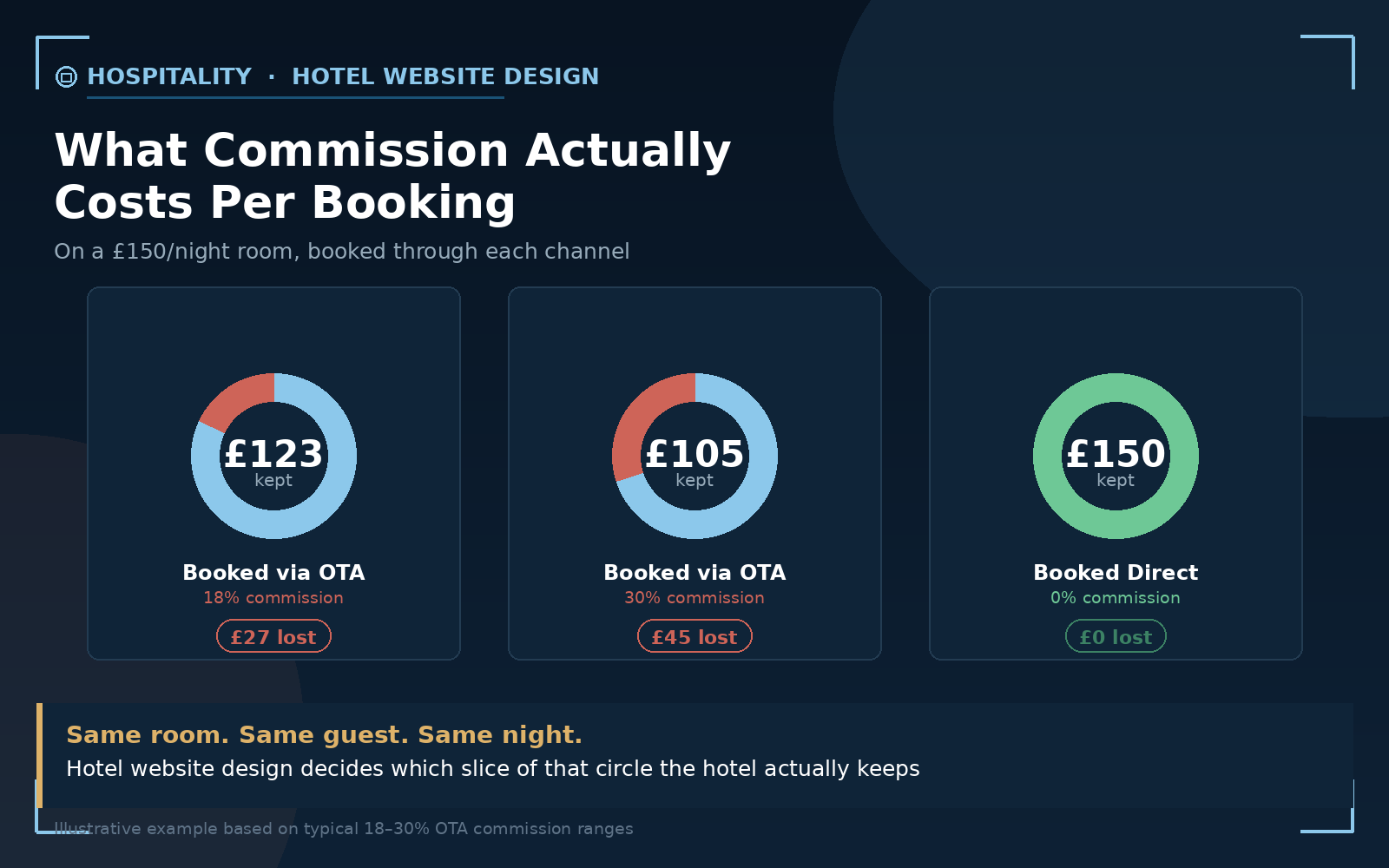
That dependence is expensive. Industry commission guides put Booking.com’s all-in cost at roughly 18–30% once visibility and preferred programmes are factored in, with Expedia sitting in a similar range. On a mid-priced room, that’s a meaningful share of the rate handed straight to a third party — money that could go toward staff, refurbishment, or the guest experience instead.
UK-specific data from UKHospitality‘s 2026 hotel booking trends report found that hotel websites generate the highest average revenue per direct booking of any channel, well above OTAs — which makes a hotel’s own site the single highest-value piece of digital real estate it owns, whether or not it’s currently being treated that way.
Signs Your Hotel Website Design Is Losing Direct Bookings
Most hotels have a rough sense their OTA commission bill feels high, but a few specific patterns in the hotel website design itself are worth checking for directly:
- The homepage takes more than a couple of seconds to load on mobile, where most last-minute and same-week bookings happen
- The booking engine takes the guest away from the site to a clunky third-party widget that doesn’t match the brand
- Room photography is dated, inconsistent, or simply thinner than what’s on the hotel’s own Booking.com listing
- Rates on the hotel’s own site aren’t clearly at parity with or better than the OTAs, so there’s no obvious reason to book direct
- There’s no easy way to see live availability without submitting an enquiry and waiting for a reply
None of this reflects the quality of the hotel or the stay itself. It reflects whether the hotel website design is actually built to compete with an OTA for the booking, rather than just existing as a digital brochure.
What Hotel Website Design Should Actually Get Right
1. A booking engine that works in two or three taps
Real-time availability and rates, booked without leaving the site or being redirected to a generic third-party page that doesn’t match the brand — every extra step between “interested” and “booked” is a chance to lose the guest back to an OTA.
2. Rates that are visibly worth booking direct for
If a guest can see the exact same or a worse rate on the hotel’s own site compared to Booking.com, there’s no reason to book direct. A visible best-rate guarantee or a small direct-only perk — free breakfast, late checkout — gives a guest an actual reason to choose the hotel’s own site.
3. Photography and content that outperforms the OTA listing
A guest comparing a hotel’s own site against its Booking.com listing should see a better representation of the property on the direct site, not a thinner one. This is also part of the trust signal that keeps a guest from bouncing back to the familiar OTA brand.
4. Fast, mobile-first performance
A large share of hotel bookings happen on a phone, often within minutes of a search. A slow-loading site loses that moment before a guest even reaches the booking engine. This is one of the most measurable levers in hotel website design, and one of the easiest to test.
Hotel Website Design: Generic Template vs. Built For Direct Bookings
| Area | Generic Hotel Template | Built For Direct Bookings |
|---|---|---|
| Booking flow | Redirects to a mismatched third-party widget | Booked in-brand, two or three taps |
| Rates | Same or worse than the OTA listing | Visibly parity or better, with a direct-only perk |
| Photography | Thinner than the OTA profile | The best representation of the property anywhere |
| Mobile speed | Slow, not built for last-minute searches | Fast, built for the moment a guest is deciding |
| Guest data | Owned by the OTA, not the hotel | Captured direct, usable for repeat bookings |
What Hotel Website Design Costs And How Long It Takes
Most independent hotels budget for this as a full rebuild — design, booking engine integration, and photography — rather than a cosmetic refresh, since a template swap alone rarely fixes the underlying commission problem. Cost depends mainly on how much existing photography and content can be reused versus rebuilt from scratch, and how the current booking engine needs to be replaced or reintegrated into the new hotel website design.
A properly built hotel website typically takes six to ten weeks from first draft to launch, including booking engine setup and testing. The commission saving starts compounding from the moment the new site and rate strategy go live — every booking that shifts from an 18–30% commission channel to a near-free direct channel is immediate, ongoing margin.
A Real Example: Hotel Website Design In Action
Picture two boutique hotels in the same town, genuinely comparable rooms and service. One’s website looks pleasant but redirects every booking attempt to a generic third-party widget that loads slowly and doesn’t match the site’s branding — and the rate shown there is identical to Booking.com. The other’s hotel website design shows live availability inline, books in three taps, and offers a small direct-only perk that isn’t available through any OTA.
A guest comparing both properties on their phone books the second hotel directly. The first hotel’s guest goes back to Booking.com — same room, same hotel quality, but the booking now costs the hotel 18-30% in commission it didn’t have to pay. Neither hotel did anything wrong on the guest experience. The entire outcome was decided by which website made booking direct the easier choice.
Why Hotel Website Design Matters Around Chipping Norton And Woodstock
Boutique hotels and guesthouses working across Chipping Norton, Woodstock, and Stratford-upon-Avon compete heavily on character and guest experience — which makes it especially frustrating when a well-run property loses a fifth or more of its rate to commission on a booking it could have taken direct. In a market where guests are actively choosing between independent character and chain predictability, hotel website design that makes direct booking effortless is often what actually converts that preference into a booking.
We work with hospitality businesses across this area to build websites around direct-booking conversion specifically, not just visual presentation. For the search visibility side that brings guests to the site in the first place, see our companion piece on Hotel SEO, and for the wider direct-booking strategy, see Holiday Let Marketing.
This is normally part of a wider website design project rather than a standalone fix, and for the broader Oxfordshire and Warwickshire market we work across, see our Banbury location hub.
Book a free strategy call: get in touch online or call +44 7498 897007 to see exactly how much commission your current site is quietly costing you.
Frequently Asked Questions
Will a better hotel website design actually reduce OTA dependence, or is that mostly rate strategy?
Both matter, but they work together. A best-in-class rate strategy with a slow, clunky booking flow still loses guests back to the OTA, and a fast, well-designed site with rates matching the OTA gives guests no reason to book direct. The two need to move together.
Do we still need to be on Booking.com and Expedia if we improve our own site?
Yes — OTAs still deliver genuine discovery and demand most independent hotels can’t replace. The goal isn’t leaving OTAs, it’s converting more of the guests who find you there, or find you organically, into direct bookings instead.
How long before we see a real shift in direct bookings?
Some shift shows up almost immediately once the booking flow itself is faster and rates are visibly competitive, since it changes the decision at the point of booking. The bigger compounding effect builds over several months as repeat guests and referral traffic increasingly default to booking direct.
Is this worth it for a small guesthouse, not just a larger hotel?
Often more so — a smaller property has less room to absorb 18-30% commission on every booking, and a guesthouse’s character is usually easier to represent well on a purpose-built site than a generic OTA listing template allows.
What’s the fastest thing to fix first?
Usually the booking flow itself — cutting the steps between “interested” and “booked,” and making sure the rate shown is visibly worth choosing over the OTA listing.
Does hotel website design affect SEO too?
Yes — page speed, mobile performance and structured, well-organized content all feed directly into how well a hotel site ranks, so hotel website design and SEO work best as one connected project rather than two separate ones.
If your website is quietly sending bookings back to the OTAs, get in touch or call +44 7498 897007 and we’ll show you exactly what’s realistic to fix first.