A prospect calls back for their third meeting and the adviser can’t remember whether the risk questionnaire was sent, whether the introducer was thanked, or what was promised in the last review. That’s not a memory problem — it’s a system problem. CRM for financial advisers exists precisely because financial advice isn’t a simple sales pipeline: it’s a regulated, long-running relationship that has to be tracked, evidenced and reviewed for years, not just closed and forgotten.
Short answer: a CRM for financial advisers needs to do more than store contact details — it has to track fact-finds, suitability records, introducer relationships, review schedules and client communications in a way that satisfies FCA Consumer Duty expectations, not just help close the next sale. A generic sales CRM forces advisers to work around features that don’t fit a regulated advice process.
Last reviewed 2 August 2026 by wren, who builds SEO, CRM and websites for professional and trade businesses across Oxfordshire and Northamptonshire.
If your current system is a mix of spreadsheets, email chains and a network CRM nobody trusts, that’s worth fixing before it becomes a compliance problem — book a free strategy call or call +44 7498 897007.
In This Guide
- Why a CRM for financial advisers is different to a sales CRM
- Signs your current system is putting the firm at risk
- What a CRM for financial advisers should actually track
- Consumer Duty and why this matters more since 2023
- Popular CRM platforms for UK advice firms
- Generic sales CRM vs. purpose-built for advice firms
- What this costs and how long it takes
- What realistic results look like
- Why this matters around Banbury and Oxfordshire
- Frequently asked questions
- Sources
Why A CRM For Financial Advisers Is Different To A Sales CRM
A typical sales CRM is built around a single moment: the deal closing. Financial advice doesn’t work that way. The relationship starts at first enquiry, moves through fact-finding, research and suitability, and then continues for years through annual reviews, life events and regulatory check-ins. The FCA’s 2025 financial advice firms survey counts roughly 5,500 advice firms in the UK, with around 31,000 advisers looking after 4.1 million clients between them — and the regulator puts the typical adviser at around 150 ongoing clients. Managing that volume of long-running, regulated relationships in a system built for one-off deals is where most of the admin burden actually comes from.
Separately, industry benchmarking from NextWealth found the average annual review takes 5.5 hours to prepare. Across a book of 150 clients, review preparation alone adds up to roughly half a working year — which is exactly the kind of admin load a properly structured CRM for financial advisers is meant to reduce.
Signs Your Current System Is Putting The Firm At Risk
Most advice firms have some kind of system in place, but a few patterns show up again and again in firms that are quietly exposed:
- Client communication records are split across email, a network CRM and personal notes, with no single source of truth
- Nobody can quickly pull up when a client’s last suitability review happened, or when the next one is due
- Introducer relationships — who referred which client, and what that relationship is worth — live in someone’s memory rather than the system
- Vulnerable client flags don’t exist anywhere formal, despite the FCA’s own guidance that roughly half the UK adult population will be classed as vulnerable at some point
- Producing management information for a Consumer Duty board report means someone manually pulling data from three different places
None of this reflects how good the advice itself is. It reflects whether the system behind the advice was ever built for a regulated, long-running relationship rather than a one-off sale.
What A CRM For Financial Advisers Should Actually Track
1. Fact-finds and suitability records
Every piece of information used to form advice — risk profile, objectives, existing arrangements — needs a permanent, accessible home, not a folder of PDFs nobody can search.
2. Review schedules and ongoing service delivery
A CRM for financial advisers should flag upcoming reviews automatically, not rely on someone remembering which of 150 clients is due a check-in this month.
3. Introducer and referral tracking
Many UK advice firms grow substantially through accountants, solicitors and other introducers, yet most generic CRMs treat that relationship as an afterthought custom field rather than a first-class part of the pipeline.
4. Client communication and vulnerability flags
Every meeting note, call and email should be logged against the client record, with the ability to flag and track vulnerable customers — something a generic sales CRM was never built to do well.
Consumer Duty And Why This Matters More Since 2023
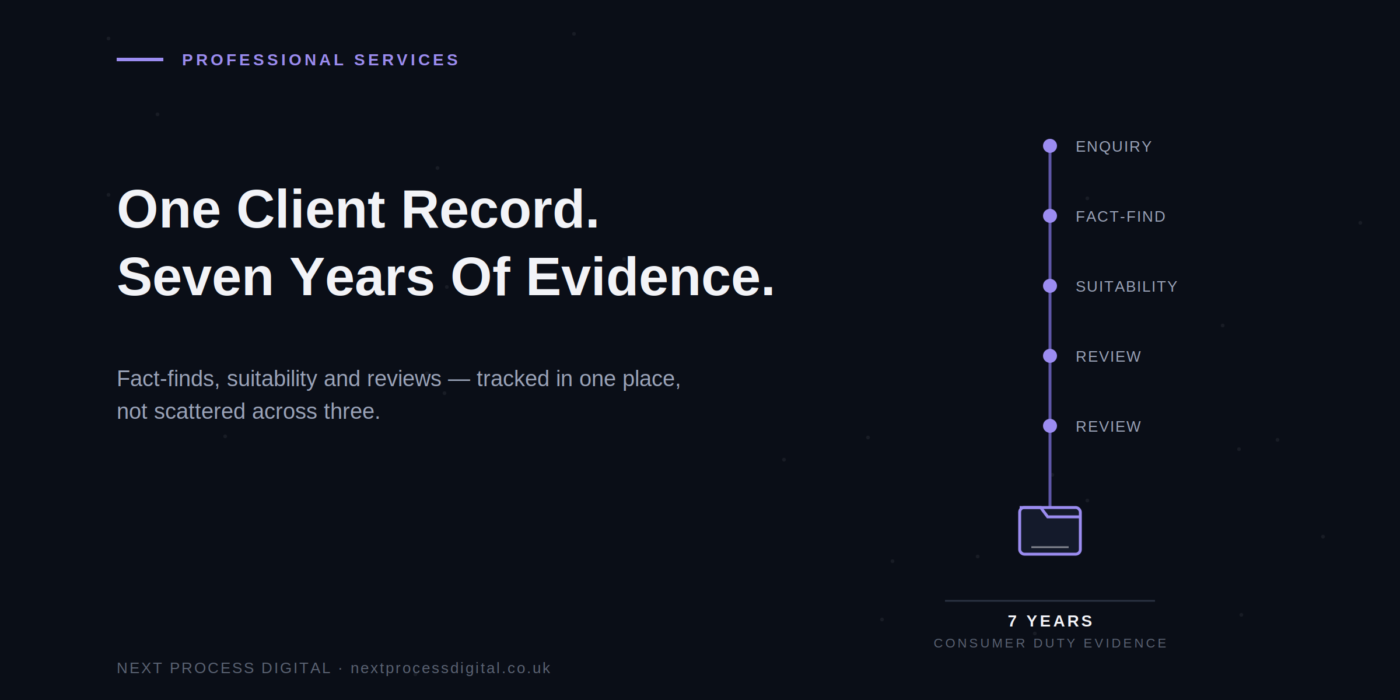
Since the FCA’s Consumer Duty came into force for open products in 2023 and closed books in 2024, the CRM effectively sits at the centre of a firm’s ability to evidence good client outcomes. It’s where suitability records live, where ongoing service delivery gets tracked, and where the management information for the annual Consumer Duty board report is generated. Get this wrong and a firm’s compliance posture, operational resilience and acquisition-readiness all suffer at the same time. The FCA’s February 2025 review of ongoing advice services requested seven years of suitability and service-delivery data from a sample of large firms — a request several firms reportedly struggled to fully answer, simply because their systems weren’t structured to produce it.
This is also where a proper marketing automation layer becomes useful rather than risky — automated review reminders and compliant follow-up sequences reduce the chance of a client being missed, while every touchpoint still gets logged for evidence purposes. We cover what that automation layer needs to do in more detail in Financial Services Automation.
Popular CRM Platforms For UK Advice Firms
Most UK advice firms choose between a handful of routes when it comes to the CRM itself, and each suits a different stage of growth:
- Established adviser-specific platforms. Intelliflo Office and Iress Xplan are the two most common purpose-built CRMs in the UK advice market, with fact-find, suitability and review-scheduling features designed around FCA requirements out of the box.
- Network-provided CRM. Many appointed representatives use whatever CRM their network mandates. This satisfies the network’s own record-keeping requirements but isn’t always a practical day-to-day workspace, which is why many firms end up running something alongside it.
- General CRM platforms adapted for advice. Tools like HubSpot or Salesforce can be configured for financial advice, but need custom fields, workflows and compliance logic added on top — they don’t arrive with fact-find or suitability structures built in.
- Custom-built CRM. A system designed specifically around a firm’s own client journey, introducer relationships and review cadence — usually worth the investment once a firm’s processes have outgrown what a template-based platform can flex to.
The right choice depends less on brand recognition and more on whether the platform can genuinely hold fact-finds, flag reviews automatically, and produce a Consumer Duty evidence trail without three other tools bolted on.
Generic Sales CRM vs. Purpose-Built For Advice Firms
| Area | Generic Sales CRM | Purpose-Built For Advice Firms |
|---|---|---|
| Client journey | One-off deal pipeline | Fact-find → suitability → ongoing review |
| Introducers | Custom field, easy to lose track of | First-class tracking with value attribution |
| Compliance evidence | Scattered across email and notes | Logged automatically against each client |
| Review scheduling | Manual, dependent on memory | Automated flags well ahead of due dates |
| Vulnerable client tracking | Rarely built in | Formal flags and review workflows |
Picture two advice firms of similar size. One tracks clients across a network CRM, a shared inbox and a spreadsheet of introducer relationships nobody fully trusts. The other has every fact-find, review date and introducer relationship in one system that flags what’s due before it’s late. When the FCA asks for seven years of suitability data, or a board member asks which introducer relationships are actually worth cultivating, only one of those firms can answer quickly — regardless of which one gives the better advice.
What This Costs And How Long It Takes
Most advice firms budget for this in one of two ways: a project cost to configure and migrate into a purpose-built CRM, or a smaller setup fee plus an ongoing platform cost. Where a firm sits on that spectrum usually depends on how much data needs migrating from existing spreadsheets, a legacy network CRM, or email records, and how many workflows (introducer tracking, review scheduling, vulnerable client flags) need building from scratch.
A properly configured CRM for a small-to-mid advice firm typically takes four to eight weeks from kickoff to go-live, including data migration and staff training. Rushing this timeline by skipping proper data migration usually costs more later, once gaps in historic client records surface during a review or an FCA request.
What Realistic Results Look Like
The clearest early win is usually time: firms that move review preparation into a structured CRM typically cut hours off each review once client history, past communications and documents sit in one place instead of three. The compliance benefit compounds over time — being able to answer a Consumer Duty data request in minutes rather than days becomes normal rather than a fire drill.
This works best alongside visibility and website work, covered in our companion piece on SEO for Financial Advisers and Website Design for Financial Advisers — a CRM fixes what happens after someone becomes a client, but it doesn’t generate new enquiries on its own.
Why This Matters Around Banbury And The Wider Oxfordshire Corridor
Independent advice firms across Banbury and the wider Bicester corridor tend to be small, close-knit practices where a handful of advisers manage a large, long-standing client book alongside a steady flow of introducer referrals from local accountants and solicitors. That combination — many long-running relationships, referral-heavy growth — is exactly where a generic CRM falls short fastest, because both the review workload and the introducer relationships are too easy to lose track of in a system that wasn’t built for either.
CRM For Financial Advisers: Frequently Asked Questions
Do we still need this if we already use our network’s CRM?
Often, yes. A network CRM supports required processes and records for the network itself, but it isn’t always built as a practical day-to-day workspace for managing client work, introducer relationships and review scheduling — many firms run a purpose-built CRM alongside their network system rather than instead of it.
How does this connect to Consumer Duty specifically?
Consumer Duty requires firms to evidence good client outcomes on an ongoing basis, not just at the point of sale. A CRM that logs communications, tracks review schedules and flags vulnerable clients gives a firm the evidence trail Consumer Duty reporting actually needs — the FCA’s own Consumer Duty page sets out what firms are expected to demonstrate.
What’s the best CRM for financial advisers in the UK?
There isn’t a single answer — Intelliflo Office and Iress Xplan cover most of the adviser-specific market, network CRMs suit firms that need to stay inside a network’s own processes, and custom builds suit firms whose client journey or introducer model has outgrown a template. The right one is whichever can actually track fact-finds, flag reviews and produce a Consumer Duty evidence trail without workarounds.
Is this only worth it for larger firms?
No — smaller firms often have more to gain, since they’re less likely to have dedicated compliance or operations staff manually filling the gaps a generic system leaves.
What happens to our existing client data during a switch?
A proper migration carries over fact-finds, communication history and documents rather than starting from a blank client list — this is the part worth taking time over, since gaps here are what create compliance risk later.
Does a CRM replace the need for good advice or client relationships?
No — it removes the admin burden around managing those relationships at scale, so advisers spend more time on the advice itself and less time chasing which client is due a review.
How does CRM work alongside marketing automation for financial advisers?
The CRM holds the client and compliance record; automation uses that data to trigger timely, pre-approved communications — review reminders, introducer thank-yous, market updates — without anyone having to remember to send them manually.
Sources
- Financial Conduct Authority — Consumer Duty
- Financial Conduct Authority — COBS 4: Communicating with clients, including financial promotions
If your current system is more spreadsheet than system, get in touch or call +44 7498 897007 and we’ll show you exactly what’s realistic to fix first.