
A friend refers a client to their financial adviser. Before calling, that client Googles the name anyway. If nothing credible comes back — no clear qualifications, no recent content, a thin or missing website — the referral quietly stalls before the call ever happens. SEO for financial advisers exists to make sure that search confirms the referral instead of undermining it.
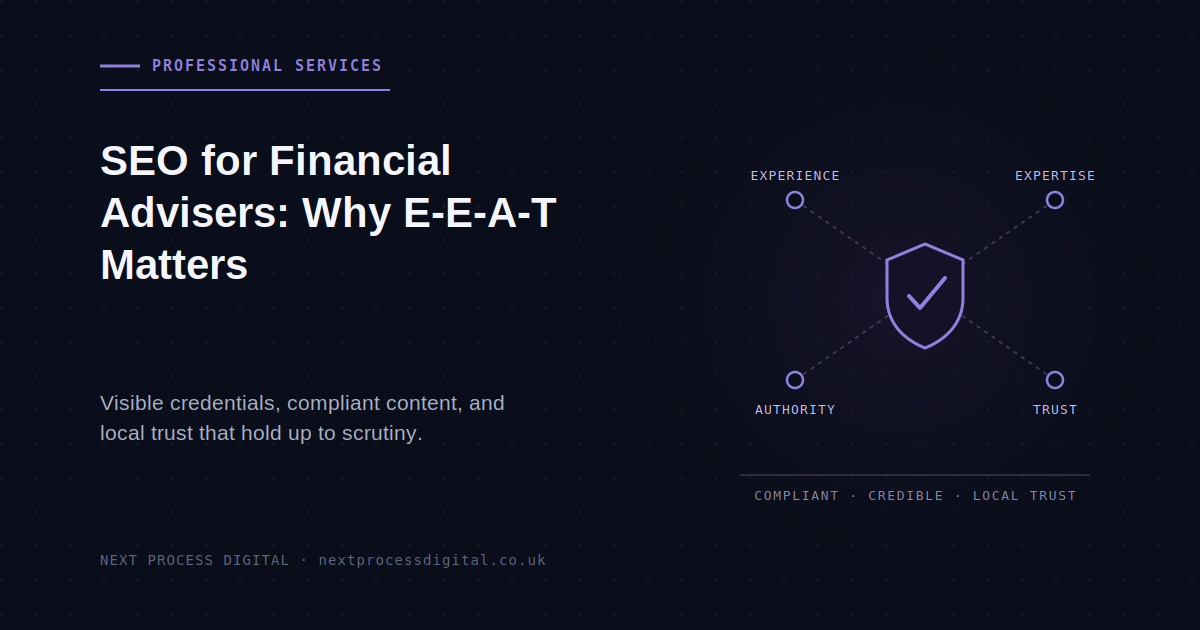
Short answer: SEO for financial advisers means building a compliant, credibility-first online presence — visible qualifications, genuinely useful content, and local visibility — built to Google’s highest evidence standard, since financial advice content falls under what Google calls “Your Money or Your Life” (YMYL). That makes E-E-A-T (Experience, Expertise, Authority, Trust) non-negotiable here in a way it isn’t for most other local businesses.
Last reviewed 2 August 2026 by wren, who builds SEO, CRM and automation systems for professional and trade businesses across Oxfordshire and Northamptonshire.
Why SEO for Financial Advisers Is Held to a Different Standard
Nearly every prospective client checks an adviser online before making contact, even when personally referred by someone they trust. Research from Alden Investment Group puts that figure at 96% — meaning an adviser’s website isn’t a nice-to-have, it’s the thing standing between a warm referral and an actual enquiry.
What makes this different from SEO for most local businesses is that Google treats financial advice as YMYL content — topics where inaccurate information could meaningfully affect someone’s finances or wellbeing. Google’s own guidance holds YMYL content to its strictest E-E-A-T bar: real, verifiable expertise; visible authority; and clear trust signals, not just keyword-optimised copy. On top of that, under the FCA’s COBS 4 rules, most adviser websites count as a financial promotion in their own right — every page has to be clear, fair, and not misleading. SEO content that overstates returns or omits relevant risk isn’t just weak content here; it’s a compliance problem.
It’s also, encouragingly, a channel that pays off when it’s done properly. Analysis by First Page Sage found financial services websites convert visitors to leads at around 5% — among the strongest of any professional services sector, largely because visitors arrive with strong intent and respond well to clear trust signals once they find them.
Signs Your Practice’s SEO Isn’t Working
Most advisers have a rough sense of how their website performs, but a few specific patterns are worth checking for directly:
- Searching your own name alongside “financial adviser” doesn’t return your site on the first page
- The website hasn’t been meaningfully updated in over a year, while competitors’ sites are actively adding content
- Qualifications and regulatory registration are mentioned once, buried on an About page, rather than reinforced across key pages
- Almost all new enquiries come through personal referral, with the website contributing little on its own
- There’s no clear content answering the questions prospects are actually asking — retirement planning, inheritance tax, pension consolidation
None of this reflects the quality of the advice being given. Plenty of excellent advisers have websites that simply aren’t doing the credibility work Google and prospects both expect — which is exactly the gap SEO for financial advisers is meant to close.
What SEO for Financial Advisers Should Actually Deliver
1. Content that demonstrates real expertise, not just keywords
Pages that explain retirement planning, inheritance tax, or pension consolidation in plain English — genuinely useful, compliant, and written to build trust rather than push a product. This is the content Google’s YMYL guidelines are specifically looking for: material that demonstrates the author actually understands the subject, not just that the page contains the right keywords.
2. Visible, verifiable credentials (the “E” and “A” in E-E-A-T)
Qualifications, regulatory registration, and years of experience displayed clearly on every key page — not just a single About page. Google’s algorithms and human quality raters both look for this kind of consistent, verifiable credibility signal, and so does a prospect scanning the site after a referral.
3. Local SEO for financial advisers building local trust
Advisers still win a large share of business through local reputation. Local SEO and a complete Google Business Profile help a search for “financial adviser Banbury” turn up a real, credible local practice rather than a national comparison site or directory listing.
4. A compliant approval process behind the content
Every piece of content needs sign-off before publication under FCA rules, so the SEO process has to include a compliance step — not just a publish button. This isn’t a bolt-on; it needs to be built into the workflow from the first content brief.
Picture two advisers in the same town, similar experience, similar client base. One has a website last updated three years ago, with qualifications mentioned once on an About page nobody reads. The other has recent, genuinely useful content on the questions clients actually ask, credentials visible on every key page, and a complete Google Business Profile with recent reviews. When a referral checks both names tonight, only one confirms what the recommendation already told them — and UK industry benchmarking from The Yardstick Agency suggests a well-run practice should be converting at least one in four enquiries that do come through.
Visibility and trust also depend on what happens once a prospect actually lands on the site — see our companion piece on Website Design for Financial Advisers for how E-E-A-T carries through into the design itself.
Two Approaches to SEO for Financial Advisers
| Area | Generic Marketing Agency | Compliance-Aware, E-E-A-T-Led |
|---|---|---|
| Content claims | May overstate results to sound persuasive | Written to be clear, fair and not misleading by default |
| Author credibility | Generic “About Us” copy | Named author with visible qualifications on every key page |
| Publishing process | Publish and move on | Built around a compliance sign-off step |
| Local visibility | Treated as an afterthought | Built to confirm local reputation the moment someone searches your name |
| Content depth | Thin service pages, rarely updated | Genuinely useful pages answering real client questions |
SEO for Financial Advisers Around Banbury and the Wider Oxfordshire Corridor
Independent financial advisers here compete heavily on personal reputation and local trust — which is exactly what a well-built, E-E-A-T-led website should reinforce, not replace. An adviser whose site confirms their credentials the moment a referral checks them out has a real edge over one whose only online presence is a directory listing.
For the wider local business landscape, see our Banbury location page, for the SEO service itself, our SEO services page, and for related professional and trade sectors, our Industries Hub.
Book a free strategy call: get in touch online or call +44 7498 897007 to see where your practice currently stands online.
SEO for Financial Advisers: Frequently Asked Questions
Why does E-E-A-T matter more in SEO for financial advisers than other local searches?
Google classifies financial advice as YMYL (Your Money or Your Life) content, holding it to its strictest evidence and credibility standard — real expertise and visible trust signals matter more here than for most other local searches.
Is SEO for financial advisers different because of FCA rules?
Yes — most adviser websites count as a financial promotion, so content has to be clear, fair and not misleading, with a compliance sign-off step built into the publishing process.
We get most of our clients through referrals already — do we need SEO for financial advisers too?
Referrals still lead to a Google search almost every time. If nothing credible comes back, some of those referrals quietly go cold before they ever call.
How long does SEO for financial advisers take to show results?
Local visibility and Google Business Profile improvements can shift within weeks. Ranking for competitive organic terms typically takes several months of consistent, compliant, E-E-A-T-led content.
What content should a financial adviser’s website actually include?
Plain-English explanations of the topics clients genuinely ask about — retirement planning, inheritance tax, pension consolidation — alongside clearly displayed qualifications and regulatory registration. Generic “About us” copy and product-pushing pages tend to underperform both with Google and with real visitors.
Does a small, sole-adviser practice need the same approach as a large firm?
If anything, more so. A sole adviser’s personal credibility is the entire product being sold, so visible, verifiable E-E-A-T signals matter even more than for a larger, more recognised firm with existing brand trust.
How does this affect enquiry quality, not just volume?
Compliant, genuinely useful content tends to pre-qualify visitors before they ever make contact — someone who has read a clear explanation of pension consolidation arrives at the enquiry already understanding roughly what they need, which tends to produce better-quality conversations than a cold, generic enquiry form.
If your practice isn’t showing up the way it should when a referral checks you out, get in touch or call +44 7498 897007 and we’ll show you exactly what’s realistic to fix first.