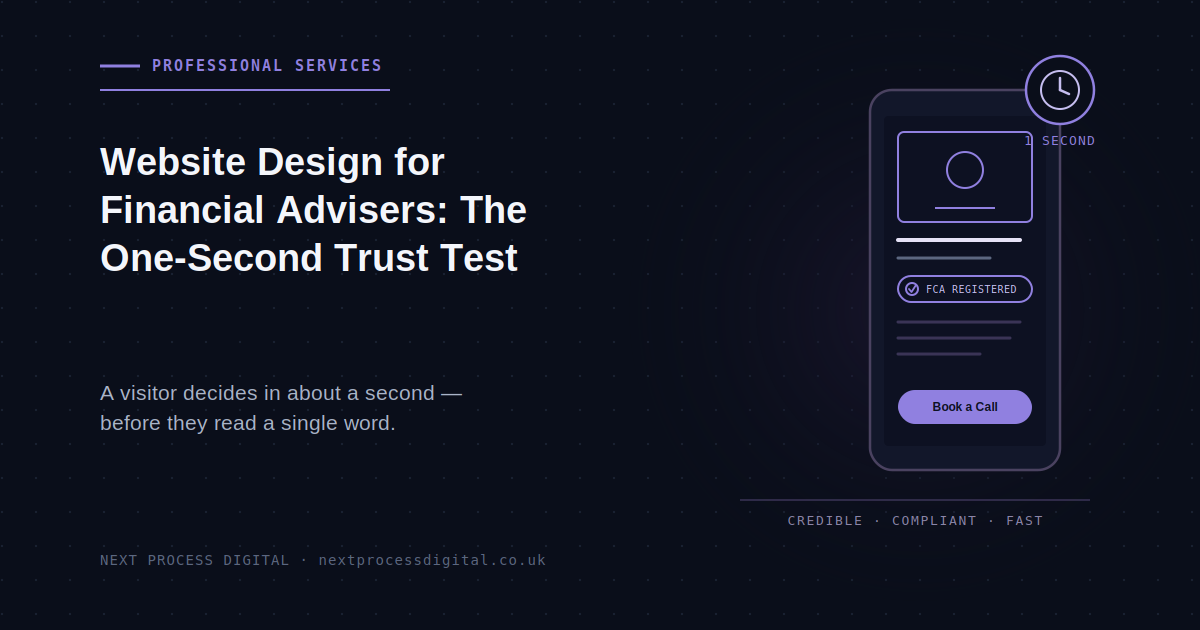

A prospect finds a financial adviser’s name after a referral, opens the website on their phone, and decides within about a second whether this looks like someone they’d trust with their retirement savings. That’s not an exaggeration — research from Stanford’s Web Credibility Project puts the figure at roughly 75% of people judging a business’s trustworthiness by design alone, almost instantly. Website design for financial advisers carries more weight than in almost any other industry, because the thing being sold is trust itself.
Short answer: good financial adviser website design needs to do two jobs at once — look credible enough in the first second to survive a snap trust judgement, and stay compliant with FCA financial promotion rules in every word underneath that first impression. A site that nails the visual trust signals but gets the compliance wrong is just as risky as one that’s compliant but looks like it hasn’t been touched since 2015.
Last reviewed 2 August 2026 by wren, who builds SEO, CRM and websites for professional and trade businesses across Oxfordshire and Northamptonshire.
If your current site is quietly losing referrals before they ever pick up the phone, that’s worth finding out now rather than later — book a free strategy call or call +44 7498 897007.
In This Guide
- Why website design for financial advisers matters
- Signs your website isn’t passing the trust test
- What website design for financial advisers should get right
- Where design meets CRM and compliant follow-up
- Generic template vs. purpose-built for advisers
- What this costs and how long it takes
- What realistic results look like
- Why this matters around Banbury and Oxfordshire
- Frequently asked questions
Why Website Design For Financial Advisers Matters More Than In Most Industries
Financial advice sits in Google’s YMYL category — Your Money or Your Life — content where getting it wrong has real consequences for the reader, which is why Google holds it to its strictest E-E-A-T bar. A site’s design is one of the fastest signals a visitor reads for trust, well before they’ve absorbed a single sentence of copy. A cluttered layout, an outdated template, or stock photography that could belong to any firm all quietly undermine the credibility the content is trying to build. Separately, Broadridge’s 2024 Financial Advisor Marketing Trends Report found 98% of advisers planned to increase spending on their websites over the following year — a strong signal that firms already recognise their existing sites are falling short.
Signs Your Website Design For Financial Advisers Isn’t Passing The Trust Test
Most advisers have a rough sense of how their site comes across, but a few specific patterns are worth checking for directly:
- The homepage takes more than a couple of seconds to load on a phone, especially over mobile data
- Stock photography stands in for a real photo of the adviser or team
- Qualifications and regulatory registration are mentioned once, if at all, buried on a separate About page
- The design hasn’t been meaningfully refreshed in several years, while competitors’ sites look current
- There’s no clear, plain-English statement near the top of who the site actually helps
- Enquiries that do come in go into a personal inbox rather than anywhere trackable
None of this reflects the quality of the advice being given. Plenty of excellent advisers are working with sites that simply haven’t kept up with what a first-second trust judgement requires — which is exactly the gap good financial adviser website design is meant to close.
What Website Design For Financial Advisers Should Actually Get Right
Whether you call it financial adviser website design or website design for financial advisers, the fundamentals below are what actually separates a site that converts from one that quietly loses referrals.
1. A first impression that reads as credible, not just modern
Clean layout, real photography of the actual adviser or team, and a clear statement of who the firm helps — not generic stock imagery that could belong to any financial services company.
2. Visible credentials above the fold
Qualifications and regulatory registration shouldn’t be buried on an “About” page three clicks deep — they belong where a visitor forms their first impression.
3. Compliant content built in from the start
Under the FCA’s COBS 4 rules, most adviser websites count as a financial promotion in their own right, meaning every page has to be clear, fair, and not misleading — a constraint that needs to shape the copy from the first draft, not get bolted on afterwards.
4. Fast, mobile-first performance
Most referral-driven searches happen on a phone within minutes of getting a recommendation. A slow-loading site loses that moment before the visitor ever sees the credentials underneath.
Where Website Design For Financial Advisers Meets CRM And Compliant Follow-Up
A trust-passing website solves the first second. What happens after someone actually enquires is a separate problem, and it’s one we see just as often with advisers as the design itself. A prospect fills in a contact form, it lands in a personal inbox alongside everything else, and by the time someone replies two days later the moment of trust the referral created has cooled off.
This is where a proper CRM system matters as much as the site itself. For an adviser, a CRM isn’t just a sales tool — it’s also where client communication records, fact-finds and suitability documentation need to live for compliance purposes. Built correctly, it means every enquiry is logged, assigned and followed up on schedule, with a clear record of what was said and when, which matters both for winning the client and for satisfying FCA record-keeping expectations.
Follow-up itself also has to stay compliant, which is where marketing automation for financial advisers looks different to most industries. A generic “nurture sequence” template written for e-commerce would breach FCA financial promotion rules within the first email. Done properly, automated follow-up for an adviser means pre-approved, compliant messaging sent on a sensible schedule — confirming next steps, sharing a compliant guide, or prompting a call booking — so a warm enquiry doesn’t go cold while everything else in the business competes for attention.
Generic Template vs. Purpose-Built For Advisers
| Area | Generic Template | Purpose-Built for Advisers |
|---|---|---|
| First impression | Stock imagery, could be any firm | Real people, clear positioning |
| Credentials | Buried on a separate page | Visible where trust is first judged |
| Compliance | Added as an afterthought, if at all | Built into the copy from the first draft |
| Enquiry handling | Personal inbox, no record trail | CRM-logged, compliant follow-up |
| Mobile performance | Slow, not optimised for referral traffic | Fast, built for the moment after a referral |
Picture two advisers in the same town, similar qualifications, similar client base. One’s website was built five years ago on a generic template — stock photography, credentials tucked away on a separate About page, a homepage that takes several seconds to load on mobile. The other’s site loads almost instantly, opens with a real photo of the adviser and a plain-English statement of who they help, and shows FCA registration details above the fold. When a referral opens both sites on their phone tonight, only one survives that first-second judgement — regardless of which adviser actually gives the better advice.
What Website Design For Financial Advisers Costs And How Long It Takes
Most advisers budget for a website project in one of two ways: a fixed project cost for a full rebuild, typically covering design, compliant copywriting and CRM integration, or a smaller initial build with an ongoing retainer covering search visibility and content once the site is live. Where a practice sits on that spectrum usually depends on how much of the groundwork — photography, credential documentation, existing compliant copy — already exists versus needing to be built from nothing.
A compliant, purpose-built site typically takes six to ten weeks from first draft to launch, once compliance sign-off is built into the process from the start rather than added at the end. Trying to compress that timeline by skipping sign-off rarely saves time overall — it usually just moves the delay to after launch, when pages have to be reworked once they turn out to be unclear or misleading under FCA rules.
What Realistic Results Look Like
Because most of the value here comes from confirming a referral rather than generating cold traffic, the impact of fixing design and enquiry handling tends to show up faster than pure SEO work — often within the first few weeks of launch, as a higher proportion of referral visits turn into booked calls rather than silently bouncing. Search visibility itself, covered in our companion piece on SEO for Financial Advisers, follows a longer curve — typically three to six months before meaningful ranking movement, since YMYL content needs to earn Google’s trust as much as a visitor’s.
The CRM and follow-up side compounds over time: once every enquiry is logged and followed up on a consistent schedule, advisers typically see fewer enquiries go quiet without explanation, simply because nothing is relying on someone remembering to reply during a busy week.
Why Website Design For Financial Advisers Matters Around Banbury And Oxfordshire
Independent advisers here compete heavily on personal reputation, which makes the website’s job simple but critical: confirm what the referral already told the prospect, in the first few seconds. A site that undermines that confirmation — through poor design or a compliance misstep — can quietly cost a firm business it should have won on reputation alone. The same applies to advisers working the wider corridor around Bicester and Brackley, where referral networks often overlap between towns.
This sits alongside visibility itself — see our companion piece on SEO for Financial Advisers for how E-E-A-T and search visibility work together before a prospect ever reaches the website. For the wider local business landscape, see our Banbury location page, for the design service itself, our website design page, and for related professional and trade sectors, our Industries Hub.
Website Design For Financial Advisers: Frequently Asked Questions
Does website design really affect client acquisition for advisers?
Yes — with most visitors forming a trust judgement almost instantly based on design, a weak site can undermine a strong referral before the prospect reads a single word of content.
Can we use a generic template to save cost?
It’s possible, but generic templates rarely handle FCA compliance requirements well and tend to look interchangeable with every other adviser using the same template — both work against building the specific trust a financial adviser needs.
How does compliance affect the design process itself?
Every page needs sign-off before publication under FCA rules, so compliance has to be considered during design and copywriting, not just checked at the end before launch.
Do we need a CRM if we’re a small, one or two-adviser practice?
Yes, if enquiries currently land in a personal inbox — not for complexity’s sake, but because a CRM gives you both a reliable follow-up system and the kind of client communication record FCA compliance expects, regardless of practice size.
Is this only relevant for larger practices?
No — a sole adviser often has more to gain from a credible, well-designed site than a larger firm, since the individual adviser’s personal credibility is the entire product being sold.
How long does a redesign for a financial adviser’s website usually take?
A compliant, purpose-built site typically takes six to ten weeks from first draft to launch, once compliance sign-off is built into the process from the start rather than added at the end.
Does website design affect SEO for financial advisers too?
Yes — page speed, mobile performance and clearly displayed credentials all feed directly into the E-E-A-T signals Google looks for in YMYL content, so financial adviser website design and SEO for financial advisers work best as one connected project rather than two separate ones.
What happens if compliance sign-off gets skipped to launch faster?
Skipping sign-off doesn’t remove the requirement — it usually just means pages get reworked after launch once they turn out to be unclear, unfair or misleading under FCA rules, which costs more time overall than building compliance in from the first draft.
If your website isn’t confirming the trust a referral already gave you, get in touch or call +44 7498 897007 and we’ll show you exactly what’s realistic to fix first.