A prospect enquires on a Friday evening, gets no response until Monday afternoon, and by then has already booked a call with a competitor who replied within the hour. That gap isn’t a staffing problem — it’s a system problem, and it’s exactly what financial services automation exists to close. Done properly, automation doesn’t replace the personal, trust-based relationship advice depends on. It protects it, by making sure nothing falls through the cracks while advisers are doing the actual client-facing work.
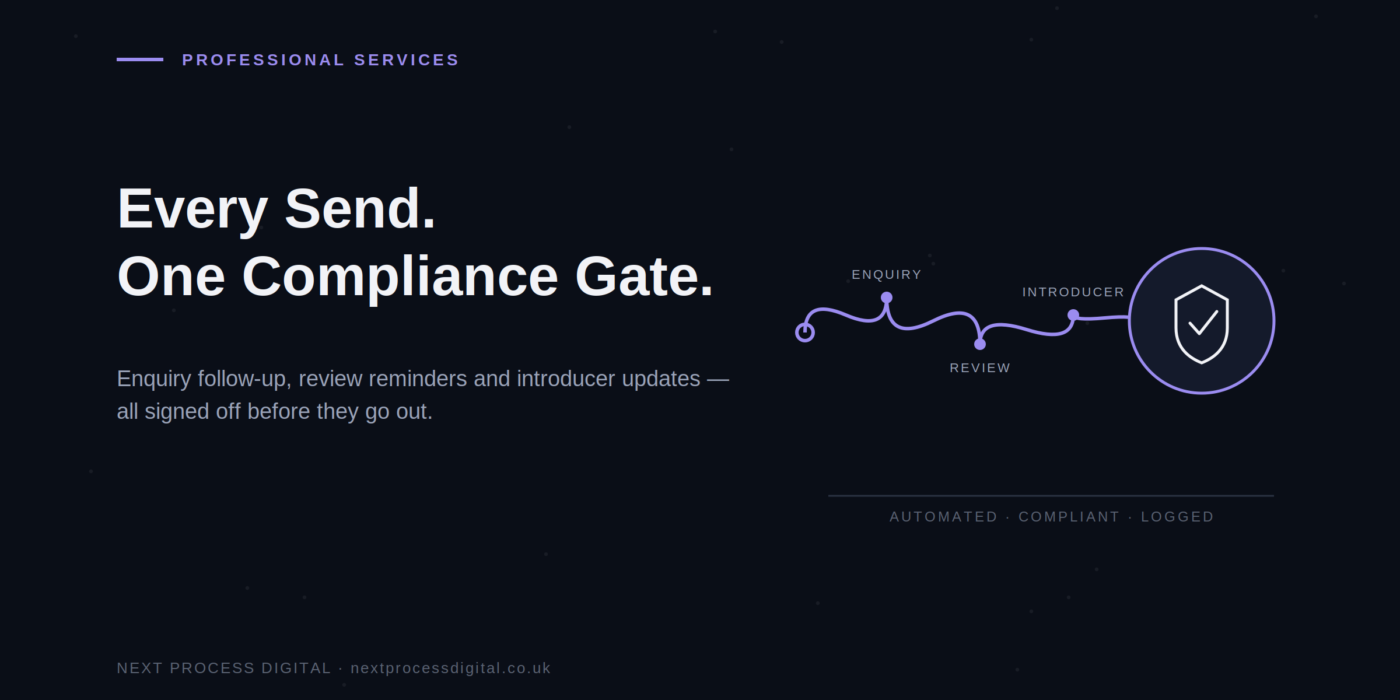
Short answer: financial services automation means using pre-approved, compliant workflows — enquiry follow-up, review reminders, introducer thank-yous, market updates — to keep client and prospect communication consistent without relying on someone remembering to send it manually. Every automated message still needs to pass the same FCA financial promotion rules as anything sent by hand.
Last reviewed 2 August 2026 by wren, who builds SEO, CRM and websites for professional and trade businesses across Oxfordshire and Northamptonshire.
If good enquiries are going quiet because nobody had time to follow up, that’s a fixable gap — book a free strategy call or call +44 7498 897007.
In This Guide
- Why automation looks different in financial services
- Signs manual follow-up is costing you clients
- What financial services automation should actually cover
- Staying compliant while automating
- Platforms UK advice firms actually use
- Generic marketing automation vs. built for advice firms
- What this costs and how long it takes
- What realistic results look like
- Why this matters around Banbury and Oxfordshire
- Frequently asked questions
- Sources
Why Automation Looks Different In Financial Services
Most marketing automation platforms are built for e-commerce or generic B2B — aggressive drip sequences, discount codes, urgency-driven subject lines. None of that works for financial advice, and most of it would breach FCA financial promotion rules within the first email. Financial services automation has to do the opposite job: maintain consistent, professional visibility with prospects and clients while staying inside strict compliance boundaries that most automation tools were never built to respect.
The need is real, though. Advisers who build genuinely engaging content, then vanish the moment client deadlines hit, lose prospects not because the content was weak but because nobody followed up while they were busy doing the actual advice work. That pattern repeats across UK advisory firms of every size, and it’s the direct cost of having no system behind the follow-up.
Signs Manual Follow-Up Is Costing You Clients
A few patterns tend to show up together in firms relying purely on manual follow-up:
- Enquiries that arrive during busy weeks get a slower response — or none at all — than enquiries that land on a quiet day
- Nobody can say how many prospects went quiet after an initial enquiry, or why
- Annual review reminders depend on someone remembering, rather than a system flagging them
- Introducers rarely hear back after sending a referral, even when the referral converts
- Content and market updates get sent in bursts when there’s time, rather than on a consistent schedule
None of this is a sign of poor advice. It’s a sign the follow-up and communication process depends on capacity that varies week to week, rather than a system that doesn’t.
What Financial Services Automation Should Actually Cover
1. Enquiry follow-up
A prospect who enquires should get an immediate, compliant acknowledgement, followed by a structured sequence that keeps the conversation moving without requiring someone to manually track every new lead.
2. Review and check-in reminders
Automated flags well ahead of a client’s annual review date mean nothing depends on someone remembering which of a large client book is due a check-in this month.
3. Introducer relationship maintenance
Automated, compliant thank-yous and periodic updates to introducers keep referral relationships warm without adding to an adviser’s weekly task list.
4. Consistent market and educational content
A scheduled, pre-approved sequence of market updates and educational content keeps a firm visible between meetings — industry-wide financial services email campaigns average around a 23% open rate, meaningfully higher than most other sectors, because clients genuinely want this information from someone they trust.
Staying Compliant While Automating
The single biggest risk in financial services automation isn’t technical — it’s compliance drift. An automated sequence set up once and left running can quietly go out of date as regulations or product details change, sending content that was compliant at launch but isn’t any more. Every automated message needs the same review and sign-off as anything sent manually, and the system itself needs a way to pause or update sequences quickly when something changes.
Under the FCA’s COBS 4 rules, an automated email or landing page counts as a financial promotion in exactly the same way a hand-written one does if it invites or induces someone to engage in investment activity — the delivery method doesn’t change the standard it has to meet.
This is also where automation and a proper CRM system have to work together rather than sit as separate tools. The CRM holds the compliance record and client data; automation uses that data to trigger the right message at the right time, with every send logged against the client record for evidence purposes. We’ve covered what the CRM side of this needs to track in more detail in CRM for Financial Advisers.
Financial Services Automation Platforms UK Advice Firms Actually Use
Most UK advice firms end up building automation on top of one of three broad approaches. None is automatically more compliant than another — the compliance sits in the review process and audit trail, not in the platform’s name — but the trade-offs differ:
- Adviser CRM with automation built in. Platforms such as Intelliflo Office and Iress Xplan include enquiry follow-up and review-reminder workflows natively, so client data and automated sends live in the same system from day one. This is usually the simplest starting point for a firm that already runs on one of these platforms.
- CRM connected to a dedicated marketing platform. A general marketing automation tool (HubSpot is the most common example advisers ask about) linked to the adviser CRM via API. This gives more design flexibility for content sequences but means compliance sign-off has to be deliberately built in as a step, since the marketing platform itself has no concept of financial promotion rules.
- Custom-built automation. Sequences built directly around a firm’s own CRM data and triggers — usually the right call once a firm has outgrown what an off-the-shelf platform’s workflow builder can handle, particularly around introducer tracking or multi-stage review cycles.
Whichever route a firm takes, the same question decides whether it’s actually safe to run: is financial promotion sign-off a genuine checkpoint inside the workflow, or something bolted on after the fact?
Generic Marketing Automation vs. Built For Advice Firms
| Area | Generic Marketing Automation | Built For Advice Firms |
|---|---|---|
| Messaging style | Urgency, discounts, aggressive sequences | Measured, educational, compliance-checked |
| Compliance review | Rarely built in | Sign-off and audit trail on every sequence |
| CRM integration | Generic contact fields | Tied to fact-finds, reviews, introducer data |
| Review reminders | Not designed for this workflow | Built around the annual review cycle |
| Record-keeping | Basic send logs | Evidence trail suitable for Consumer Duty reporting |
Picture two advice firms with similar enquiry volume. One relies on advisers remembering to follow up between meetings, with content sent in bursts whenever there’s time. The other has enquiry follow-up, review reminders and introducer updates running automatically, each one pre-approved and logged. Six months later, the second firm has kept more prospects warm through a long decision cycle, missed fewer review dates, and can produce a full communication record for any client in seconds — all without adding headcount.
What This Costs And How Long It Takes
Most firms budget for this as either a setup project layered onto an existing CRM, or a combined CRM-and-automation build for firms starting from scratch. Cost depends heavily on how many sequences need building (enquiry follow-up, review reminders, introducer updates, content scheduling) and how much compliance review each one needs before going live.
A focused automation setup on top of an existing CRM typically takes two to four weeks; a combined CRM-and-automation build from nothing usually takes six to ten weeks, since the automation logic depends on the CRM structure being right first.
What Realistic Results Look Like
The fastest visible change is usually response time — enquiries get an immediate, compliant acknowledgement regardless of what day or time they arrive, which matters most in the early stage of a decision when a prospect is often comparing more than one adviser. Review completion rates typically improve over the following months as automated reminders replace memory-dependent scheduling, and introducer relationships tend to strengthen simply because they’re being maintained consistently rather than only when there’s spare time.
This works best paired with the website and visibility side, covered in our companion pieces on SEO for Financial Advisers and Website Design for Financial Advisers — automation keeps enquiries warm once they arrive, but it doesn’t generate them on its own.
Why This Matters Around Banbury And The Wider Oxfordshire Corridor
Advice firms across Banbury and Bicester tend to run lean, with a small number of advisers covering client work, business development and admin at once. That’s exactly the environment where manual follow-up breaks down fastest — a busy fortnight of client meetings is enough for enquiries and introducer updates to quietly slip, and financial services automation is what keeps that from happening without adding to anyone’s workload.
Financial Services Automation: Frequently Asked Questions
Will automated messages feel impersonal to clients?
Not if it’s built properly. Segmented, relevant messaging timed around genuine milestones — a review due date, a market event — tends to feel more attentive, not less, because it’s consistent rather than sporadic.
Is marketing automation actually compliant for financial advisers?
It can be, but only with proper oversight. Every automated email, landing page or sequence needs to follow the same financial promotion rules and sign-off process as anything sent manually, with approval checkpoints built into the workflow itself.
What is the FCA rule on automated financial promotions specifically?
An automated message is still a financial promotion under COBS 4 if it invites or induces engagement in investment activity, so it needs to be fair, clear and not misleading, and it needs the same approval trail as anything sent by hand. There’s no automation exemption — the rule applies to the content, not the delivery method.
Do we need a new CRM to start automating?
Not necessarily, provided your existing CRM can integrate with an automation platform. Most modern UK adviser CRMs support this via API — if yours genuinely can’t, that’s usually a sign it’s worth reviewing the CRM itself.
What should we automate first?
Enquiry follow-up is almost always the highest-leverage starting point, since it directly affects whether a warm prospect stays warm during the early, most competitive stage of their decision.
How does this reduce compliance risk rather than increase it?
Automation that’s properly built logs every send against the client record automatically, which creates a more complete and consistent evidence trail than manual communication ever does — the risk comes from sequences that aren’t reviewed or updated, not from automation itself.
Does automation replace the need for a good website or SEO?
No — automation nurtures enquiries once they arrive. It doesn’t generate new ones on its own, which is why it works best alongside proper search visibility and a website built to convert referral and search traffic in the first place.
Sources
- Financial Conduct Authority — COBS 4: Communicating with clients, including financial promotions
- Financial Conduct Authority — Consumer Duty
If good enquiries are quietly going cold after the first message, get in touch or call +44 7498 897007 and we’ll show you exactly what’s realistic to fix first.