By the time a procurement manager fills in a contact form, they’ve usually already decided who they want to work with. Research on industrial buyers found that 57% have settled on a preferred vendor direction before their first conversation with a sales representative, and separately, B2B buyers review an average of 11 pieces of content before reaching out to any supplier at all. Engineering website design either earns your business a place in that shortlist, or quietly rules you out of it before anyone ever picks up the phone.
Short answer: engineering website design that converts isn’t about looking modern — it’s about giving a technical buyer the specific proof they need before they’ll ever pick up the phone. That means dedicated capability pages instead of one generic services page, real tolerances and certifications instead of vague quality claims, case studies with actual numbers, and a fast, simple way to get a quote once someone’s ready to enquire. Most engineering websites lose buyers not because they look dated, but because they never give the buyer enough to actually decide.
Last reviewed 31 July 2026 by wren, who design and build websites for engineering and manufacturing businesses across Oxfordshire and Northamptonshire.
This isn’t just a hunch about how procurement teams behave. Research compiled by Optimum7, drawing on WebFX industrial marketing data, found that 98% of industrial manufacturers now generate leads through digital channels, and that by the time most industrial companies connect with a prospect, that buyer has already done the majority of their evaluation independently. Separate research from Sopro found B2B buyers review an average of 11 pieces of content before contacting a vendor, with 72% starting that research online. A website that doesn’t hold up to that scrutiny simply isn’t in the running by the time anyone would think to call.
Why Most Engineering Websites Lose Buyers Before They Ever Enquire
Most engineering company websites were built to prove the business exists — a logo, a list of services, a phone number, a gallery of finished parts. That was reasonable when most work came through referrals and the website was a formality. It doesn’t hold up against a buyer comparing three or four suppliers online before ever making contact.
The problem usually isn’t visual design. A site can look sharp and still fail completely at engineering website design’s actual job: giving a technical buyer the specific information they need to shortlist you, without them having to ask.
Signs Your Engineering Website Is Losing Buyers Silently
- Traffic looks reasonable but enquiries are rare, and almost all new business still comes from referrals
- One “Services” page tries to cover every capability, material, and industry served at once
- There’s no way to check tolerances, certifications, or typical lead times without contacting the business directly
- Case studies, if they exist, describe the work in vague terms with no real numbers attached
- Getting a quote means emailing a drawing and waiting, with no structured way to submit an RFQ
None of this reflects the quality of the engineering itself. It reflects whether the site was ever built around how a procurement manager actually evaluates a supplier online, rather than how the business wants to describe itself.
Picture two precision engineering firms with genuinely comparable capability. One has a single “Services” page mentioning milling, turning, and fabrication in a paragraph, with a “contact us” box as the only path to a quote. The other has dedicated pages for each capability, ISO 9001 and AS9100 displayed clearly, two detailed case studies with real tolerances and turnaround times, and a structured RFQ form. A procurement manager comparing both will typically shortlist the second firm within minutes — not because the work is better, but because it was easier to verify.
Want to see exactly where your website is losing buyers before they ever get in touch? Get in touch or call us on 07498 897007 and we’ll show you.
What Actually Converts A Technical Buyer
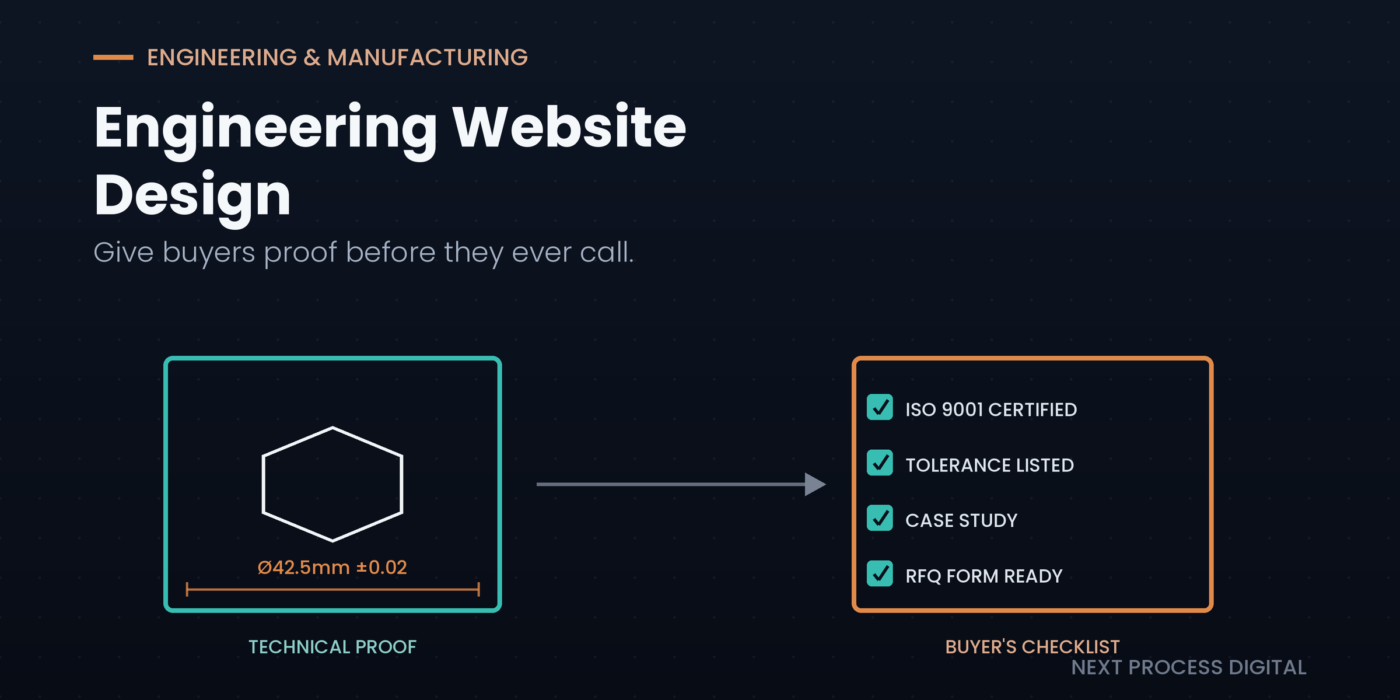
- Dedicated capability pages — separate pages for CNC machining, fabrication, assembly, or whatever your core capabilities are, each with real tolerance and material detail, rather than one page trying to cover everything at once
- Certifications displayed clearly — ISO 9001, AS9100, or sector-specific accreditations shown prominently, since they’re often the first thing a cautious buyer checks
- Case studies with real numbers — the material, the tolerance achieved, the turnaround time; specificity is what makes a case study useful rather than decorative
- A structured RFQ process — a proper quote request form capturing part details, material, and quantity, rather than a generic “contact us” box
- Content answering technical questions — pages explaining tolerance capabilities, material selection, or typical lead times capture buyers earlier in their research, before they’ve built a shortlist
Quick Reference: Digital Brochure vs. Conversion-Focused Engineering Site
| Digital brochure | Conversion-focused site |
|---|---|
| One generic “Services” page | Dedicated pages per capability, material, and industry |
| Vague quality claims, no certifications shown | Certifications and accreditations displayed clearly |
| Case studies with no real detail | Specific tolerances, materials, and turnaround times |
| “Email us your drawing” as the only option | Structured RFQ form capturing the details buyers expect to give |
| No content beyond the services list | Technical content capturing buyers earlier in their research |
Where Design Meets What Happens Next
A website that converts well still only gets you halfway. Once RFQs start coming in more consistently, they need somewhere to go beyond an inbox — the same gap we’ve covered in our piece on CRM for engineering companies. We’ve also written specifically about why engineering websites fail to generate enquiries in the first place, and about the practical side of ranking for CNC machining services so those enquiries exist to convert in the first place. Design, visibility, and follow-up all need to work together — a well-designed site with no traffic, or a well-ranked site that never converts, both leave the same amount of work on the table.
What This Looks Like For Engineering Firms Around Banbury
Engineering and manufacturing businesses across Banbury and the wider Oxfordshire and Northamptonshire corridor are often competing for the same buyers as several other precision firms in the area. In that environment, a website that actually gives a procurement manager what they need — tolerances, certifications, a proper RFQ process — is frequently the difference between making a shortlist and being ruled out before anyone ever calls. We work with engineering and manufacturing businesses across this corridor to build exactly that kind of site, tied to a CRM that makes sure the enquiries it generates actually convert into work.
Frequently Asked Questions
Does our website need a full redesign, or can we fix specific pages?
Often specific pages first — adding dedicated capability pages, certifications, and a proper RFQ form can meaningfully improve conversion without a full rebuild. A redesign helps once those fundamentals are already in place.
How important are case studies compared to the rest of the site?
Very — they’re often what convinces a cautious buyer to actually make contact rather than move to the next search result. Even two or three detailed case studies with real numbers outperform a page of generic quality claims.
Should we publish pricing on an engineering website?
Rarely in exact terms, since most engineering work is quote-specific. What matters more is making the RFQ process fast and structured, so a buyer isn’t put off by an unclear or slow path to getting a number.
How long does it take to see more enquiries after improving the website?
Structural improvements like capability pages and a proper RFQ form can lift conversion on existing traffic within weeks. Growing overall traffic through content and SEO builds over a longer timeframe.
Do we need a mobile-optimised site for engineering buyers?
Yes — procurement managers increasingly research and even submit initial enquiries from a phone, particularly earlier in their research before they’ve narrowed their shortlist.
What’s the single highest-impact change we could make first?
Splitting a generic services page into dedicated capability pages, each with real tolerance and material detail. It’s usually the fastest structural change to make and the one that most directly matches how buyers actually search.
If your website looks the part but enquiries aren’t following, the fastest way to find out why is a proper look at what a technical buyer actually sees when they land on it. Get in touch or call 07498 897007 and we’ll show you exactly what’s realistic to fix first.