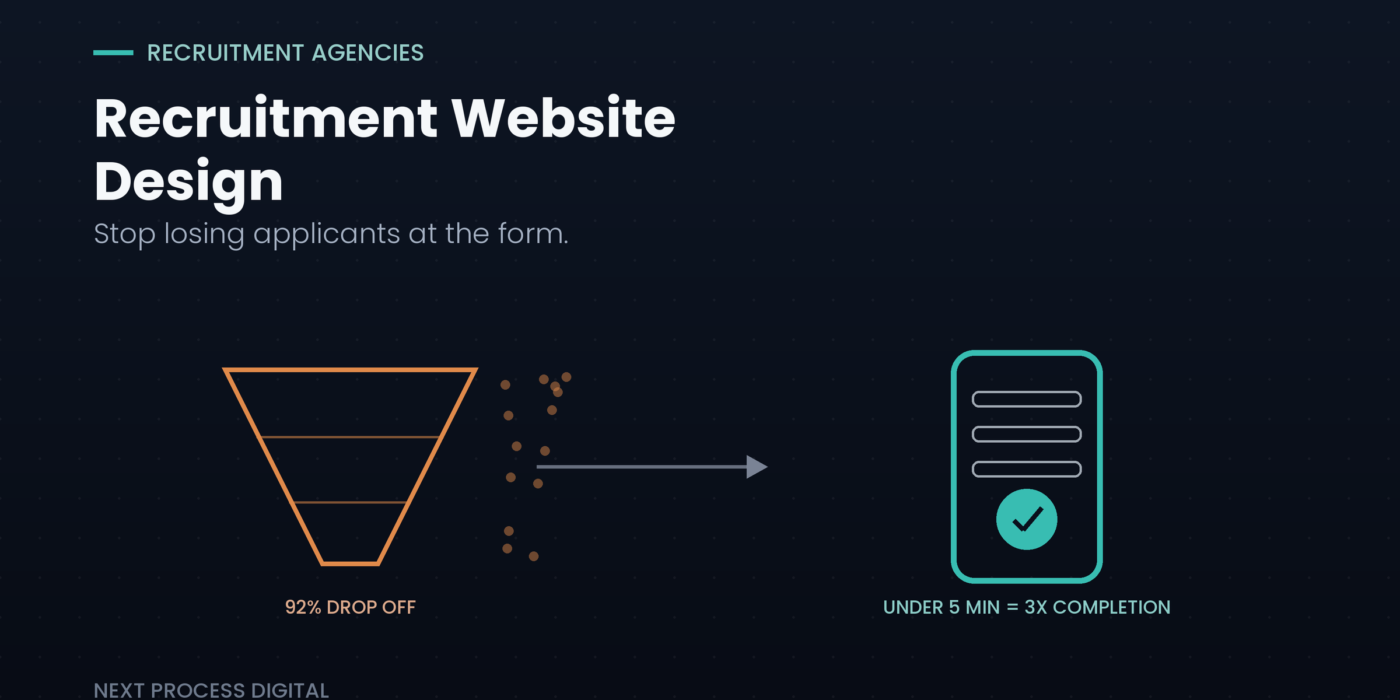
A candidate clicks “Apply.” The form asks for their education history back to secondary school. They close the tab. According to SHRM, 92% of people who click “Apply” never actually finish the application. Recruitment website design either makes it easy enough that candidates and clients follow through. Or it quietly bleeds out most of the interest your marketing just paid to generate.
Short answer: Good recruitment website design does four things. It keeps the application short and mobile-friendly (under five minutes). It gives candidates and clients separate pages, rather than one generic site. It marks up live job listings so they appear in Google’s dedicated jobs search. And it gives clients a fast, simple way to enquire about a vacancy. Most recruitment sites don’t lose people through bad branding. They lose them through friction — long forms, unclear next steps, and no reason to finish what they started.
Last reviewed 1 August 2026 by wren, who design websites and CRM systems for recruitment agencies across Oxfordshire and Northamptonshire.
This isn’t just a hunch about how candidates behave. SHRM research found that 92% of people who click “Apply” never finish the application. More than half quit purely because of length or complexity. Separate data comes from recruitment marketing platform Appcast. It found that applications taking under five minutes complete at a rate of 12.47%. Applications over fifteen minutes complete at just 3.61% — less than a third as often. For an agency spending money to attract candidates, that gap matters a lot. It decides whether a campaign pays for itself, or wastes most of its budget on people who never finish applying.

Why Most Recruitment Website Design Loses Candidates Before They Convert
Most agencies build their website around one audience — usually clients. Candidates often become an afterthought, bolted onto a jobs board plugin. Teams tend to copy the application form from a generic template. Nobody times how long it actually takes to complete on a phone. So the site quietly loses most of the interest it worked to generate.
The problem is rarely the design in a visual sense. A site can look polished and still fail at its real job. Recruitment website design has one task: get a truly interested candidate or client all the way through. That means a completed application or enquiry, without extra friction along the way.
Signs Your Recruitment Website Design Is Losing Candidates And Clients
- Job listings get clicks, but application completions stay rare, and nobody can see where people drop off
- The application form asks for more detail than it needs to shortlist someone
- Individual job adverts don’t appear in Google’s dedicated jobs search results at all
- Candidate and client content sits on the same generic pages, and serves neither audience well
- A client briefing a vacancy has to email back and forth, instead of filling in a simple form
None of this reflects the quality of the placements an agency makes. It reflects something simpler: did the agency build the site around how candidates and clients actually behave online? Or around how the agency wants to present itself?
Picture two agencies running similar job ads for the same role. One has a ten-field application form with no mobile optimisation. The other has a three-field quick-apply option that takes under two minutes on a phone. Both attract the same volume of clicks. But the second agency ends up with several times more completed applications from the same traffic. Not because the roles are more appealing — because finishing the process is actually realistic.
Want to see exactly where your website is losing candidates and clients right now? Get in touch or call 07498 897007 and we’ll show you.
What Great Recruitment Website Design Gets People To Finish
- A truly short first step — a quick-apply option that captures only what’s needed to shortlist someone. Fuller detail comes later, once there’s real interest on both sides
- Mobile-first application flow — tested on an actual phone, not just resized from a desktop layout. Most candidates apply on mobile
- JobPosting structured data — markup that makes individual roles eligible for Google’s dedicated jobs search results, not just standard listings
- Separate candidate and client journeys — distinct pages and calls to action for each audience. Not one generic site trying to serve both
- A simple client enquiry path — a short form to brief a vacancy. No phone call or lengthy email needed
Quick Reference: Friction-Heavy vs. Conversion-Focused Recruitment Website Design
| Friction-heavy | Conversion-focused |
|---|---|
| Long application form, desktop-first | Short quick-apply, tested and built for mobile |
| Jobs invisible in Google’s dedicated jobs search | JobPosting schema makes every role eligible |
| One generic site for candidates and clients | Separate journeys built for each audience |
| Client briefing requires email or a call | Simple form captures the brief in minutes |
| No visibility on where people drop off | Tracked funnel showing exactly where friction sits |
Where Recruitment Website Design Meets Visibility And Follow-Up
A well-designed site still needs people to find it. We’ve written separately about SEO for recruitment agencies and the job schema that helps roles surface in search. Once candidates and client briefs start coming in more steadily, agencies need a system to track them properly. That’s the gap covered in our piece on CRM for recruitment agencies. Design, visibility, and follow-up all have to work together. A beautifully designed site nobody finds leaves placements on the table. So does a well-found site that loses people at the application form.
What Recruitment Website Design Looks Like For Agencies Around Brackley
Recruitment agencies working across Brackley and the wider engineering corridor often compete for the same specialist candidates and client briefs as several other agencies. In that environment, a website matters. It needs to get candidates through the application, and clients through a quick enquiry. That’s often the difference between winning a placement and losing it to an easier competitor. We build exactly that kind of site for recruitment businesses across this area, tied to a CRM that keeps every candidate and client moving once they’ve made contact.
Frequently Asked Questions About Recruitment Website Design
How short should a job application actually be?
Under five minutes for the initial step, ideally closer to two. Save detailed information — full work history, references, right-to-work documents — for once there’s genuine mutual interest. Don’t front-load it into the first form.
Do we need separate websites for candidates and clients?
Not necessarily separate domains, but distinct sections, navigation, and calls to action within the same site. Identical pages for both audiences tend to underperform for each.
How much does application length actually affect completion rates?
A lot. Applications under five minutes complete at more than three times the rate of applications over fifteen minutes. Cutting unnecessary fields is often the single highest-leverage change you can make.
Will a shorter application mean lower-quality candidates?
Not usually. A short first step filters on genuine interest and basic fit. Deeper screening happens in the next stage, once someone’s already engaged — not before they’ve even applied.
How long does it take to rebuild a recruitment website design properly?
A focused rebuild — application flow, job schema, separate candidate and client journeys — can typically launch within a few weeks. Teams add refinements once real usage data comes in.
What’s the single highest-impact change we could make first?
Time your current application on a phone. Cut anything you don’t genuinely need for an initial shortlist decision. It’s usually the fastest, cheapest change with the biggest effect on completion rates.
If candidates and clients are clicking through but not converting, find out why. Take a proper look at your current recruitment website design, application, and enquiry flow. Get in touch or call 07498 897007 and we’ll show you exactly what’s realistic to fix first.